PARMA, Ohio — A reply posted this week to protester social media, under the name of Boki Lemajić, one of the visible organizers of the group opposing the October 2025 transfer at Saint Sava Serbian Orthodox Cathedral, said the group had "stood outside protesting when it was -20°." The National Weather Service's observations for Cleveland show that no such day occurred. The reply was written against this publication's September 1 report on the group's appeal to the Holy Synod. It quoted the report's closing line, called the report trash and its central comparison a joke, and did not address either of the two facts the report rested on.
This publication does not, as a rule, answer posts of this kind. It answers this one because the post made claims that can be checked, and because checking them shows something about the rest.
I. The temperature
The National Oceanic and Atmospheric Administration maintains the official climate record for Cleveland at Cleveland Hopkins International Airport, about seven miles from the cathedral on Broadview Road. The observations run continuously from May 1938. The National Weather Service office in Cleveland publishes the same observations in its monthly climate sheets.
For the period from October 1, 2025 through September 1, 2026, the coldest day of the year was Friday, January 30, 2026, when the low reached -10°F. The group does not gather on Fridays. The coldest Sunday was February 8, 2026, when the temperature fell to -7°F before dawn. Hourly observations at the airport recorded 10°F at 9:51 that morning, 14°F at 10:51, with Liturgy underway, and 16°F shortly before one in the afternoon. Those were the two coldest days of the winter, and the only two on which the low fell below -3°F. The next coldest Sunday mornings, in December and January, stood between 12°F and 14°F at ten o'clock. Every other Sunday from November through March was at least that warm during services.
The figure in the post was -20°. If it was meant in Fahrenheit, that temperature has been recorded at Cleveland Hopkins once in eighty-eight years, on January 19, 1994, and it is the all-time record low for the city. If it was meant in Celsius, which is -4°F, the only Sunday of the year to touch it did so at three in the morning, seven hours before anyone arrived on Broadview Road.
The winter was cold. It was not -20°, and the number was not taken from any record. It was chosen.
II. The election
The post said the Bishop was not "saborno izabran," not elected by the Assembly, and that Patriarch Pavle had stayed away from his consecration because he did not want to be there.
The Church's own account is available to anyone. The announcement of the Bishop's 2016 enthronement, published by the Serbian Orthodox Church in North, Central and South America, records that he was elevated to archimandrite on June 18, 2006 at the request of Patriarch Pavle; that the Holy Assembly of Bishops elected him Bishop of Australia and New Zealand in 2006; that he was consecrated on July 15, 2006 in the Cathedral of the Holy Archangel Michael in Belgrade by Metropolitan Amfilohije of Montenegro and the Littoral together with sixteen other bishops; and that the same Assembly elected him to the Diocese of Eastern America in May 2016.
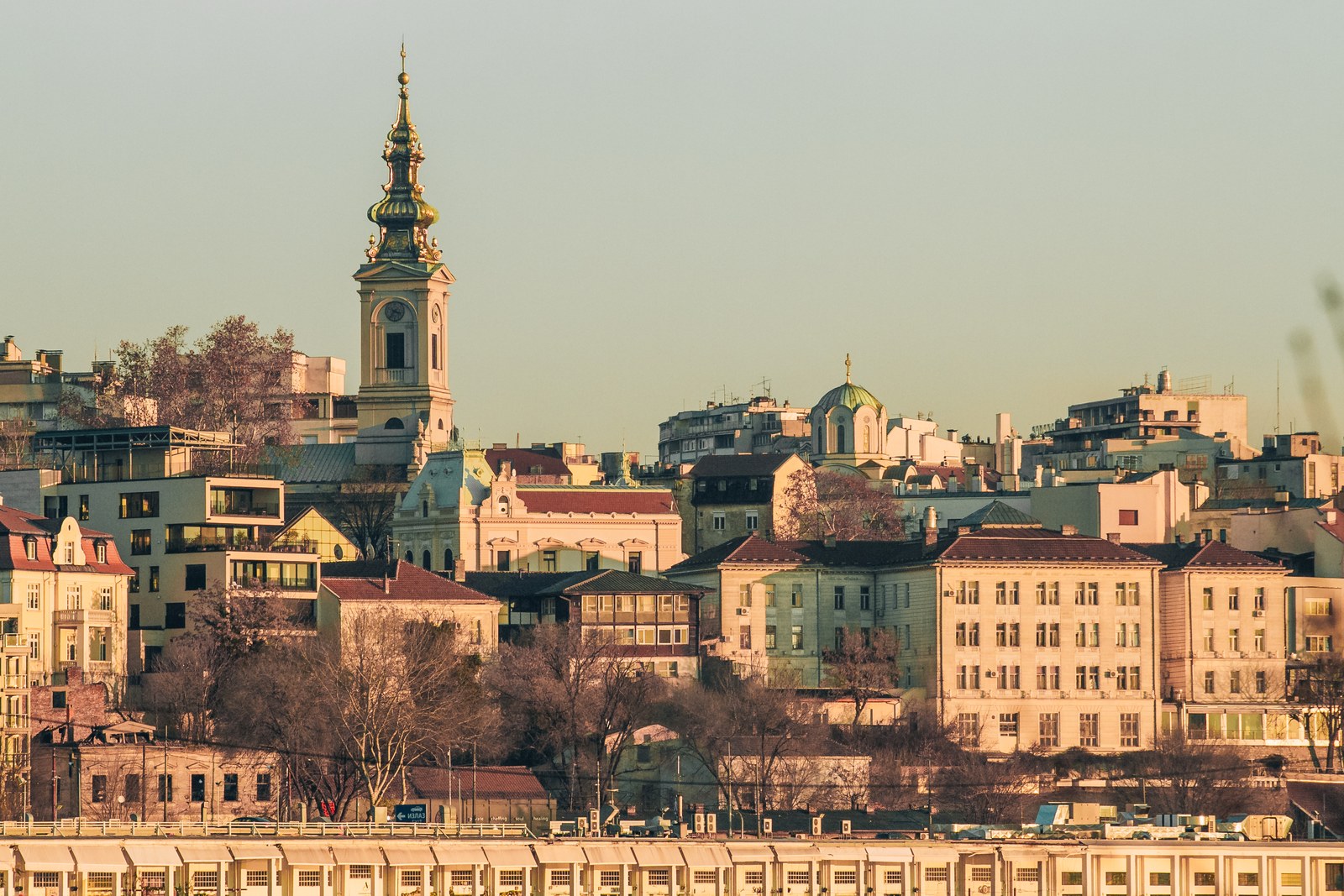
The Cathedral Church of the Holy Archangel Michael in Belgrade, where Patriarch Pavle officiated in the rite of election on July 14, 2006. Photo: DarkouPH, Wikimedia Commons, CC BY-SA 4.0.
The Diocese's own account of those days, published on July 15, 2026 to mark the twentieth anniversary of the consecration, supplies the detail the post got backwards. On Friday, July 14, 2006, in the Belgrade Cathedral, Patriarch Pavle himself officiated in the rite of election, with two metropolitans and a line of bishops concelebrating. The consecration the next day was performed, as consecrations ordinarily are, by a senior metropolitan with the assembled hierarchy. The Patriarch was ninety-one years old. He presided over the rite that made the election, and the post's account of his absence is an account of a motive it invented for a day it did not check.
The Assembly has since spoken twice more. On May 18, 2024 it expanded the Bishop's title to Washington-New York and Eastern America. In May 2026 it received the reports on the diaspora dioceses, including this one, and recorded no further action. A man elected by the Assembly in 2006, elected again in 2016, retitled in 2024, and heard without objection in 2026 is the Assembly's bishop by every measure the Church possesses.
III. The group's own words
The reply ran to some seven hundred and fifty words. The appeal it was defending appears in none of them. The Synod, whose ruling the group has promised to accept, appears twice, and both times as a body the author imagines has ruled against the Bishop, never as the body that will rule on the group's own case. The Bishop appears in nearly every sentence: by his baptismal name, by his house, by his consecration, by his first diocese and his second, by his name day, and by the twenty years between. The group's case is not argued. The Bishop is. It is the reply of a man who was given a page to defend his cause and could not take his eyes off one other person long enough to mention it.
Four days before the reply, on August 31, the group posted a statement of principles. It professed "unity and loyalty" to the Serbian Orthodox Church under Patriarch Porfirije. It said it respected the authority of the Holy Synod. It said it awaited the Synod's decision on its appeal and would abide by it. It flatly rejected any suggestion of schism. And it closed with a sentence written, presumably, for occasions such as this one: any statement made in contradiction to those principles "reflects the personal opinion of its author alone."
The reply called the Patriarch's Assembly-elected bishop illegitimate, said he was "not Belgrade's bishop," and described his twenty years in office as terror. This publication takes the group's August 31 statement at its word. The reply is the personal opinion of its author alone, and the group has said in advance that it does not speak for them.
The post also asserted that the Synod and the Patriarch had issued formal decisions against the Bishop on matters of governance and property. It cited none. Decisions of the Holy Synod are numbered documents with dates. This publication has published the ones it relies on, with links, and will do the same for any the group can produce.
IV. What was not answered
The September 1 report made two points, and the reply passed over both.
The first is that on July 13, 2026 the Holy Synod, defending the Patriarch against a Slovenian court, said that the appointment and transfer of parish priests fall under the inalienable canonical rights of the competent bishop, prescribed by the Constitution of the Serbian Orthodox Church. The second is that the group's appeal asks that same Synod to review a diocesan bishop's transfer of a parish priest, and that the group has promised in writing to abide by the answer.
Nothing in the reply disputes the Synod's words. Nothing in it withdraws the promise. What it offers instead is a temperature that never happened, an absence that never occurred, and an election that the Church has confirmed four times. When the easiest fact in a statement is invented, the reader has been told how much care went into the rest.
Saint Sava Cathedral holds Divine Liturgy every Sunday at 10 a.m. The doors are open. It is warmer inside.
Sources and Further Reading
- National Oceanic and Atmospheric Administration, National Centers for Environmental Information, Daily Summaries (GHCN-Daily), station USW00014820, Cleveland Hopkins International Airport, October 1, 2025 to September 1, 2026, and period of record from May 1, 1938. https://www.ncei.noaa.gov/cdo-web/
- National Weather Service, Cleveland, Preliminary Monthly Climate Data (CF6), January 2026 and February 2026.
- Hourly surface observations, Cleveland Hopkins (KCLE), Automated Surface Observing System, via Iowa Environmental Mesonet, Iowa State University. https://mesonet.agron.iastate.edu/
- Serbian Orthodox Diocese of Eastern America, "Twenty Years of Hierarchical Service of His Grace Bishop Irinej of Washington-New York and Eastern America," July 15, 2026. https://www.easterndiocese.org/news_260715
- Serbian Orthodox Church in North, Central and South America, announcement of the enthronement of Bishop Irinej, August 24, 2016. https://serborth.org/08242016
- Holy Synod of Bishops of the Serbian Orthodox Church, statement of July 13, 2026. https://spc.rs/sr/news/aktuelno/17178.saopstenje-za-javnost-svetog-arhijerejskog-sinoda-srpske-pravoslavne-crkve.html
- Communiqué of the Holy Assembly of Bishops, May 2026. https://easterndiocese.org/news/2960/communique-of-the-holy-assembly-of-bishops/
- Statement posted to protester social media, August 31, 2026, and reply posted under the name Boki Lemajić, September 2026. Screenshots held by Orthodox Integrity.
The NOAA climate record for Cleveland Hopkins International Airport is available at: https://www.ncei.noaa.gov/cdo-web/