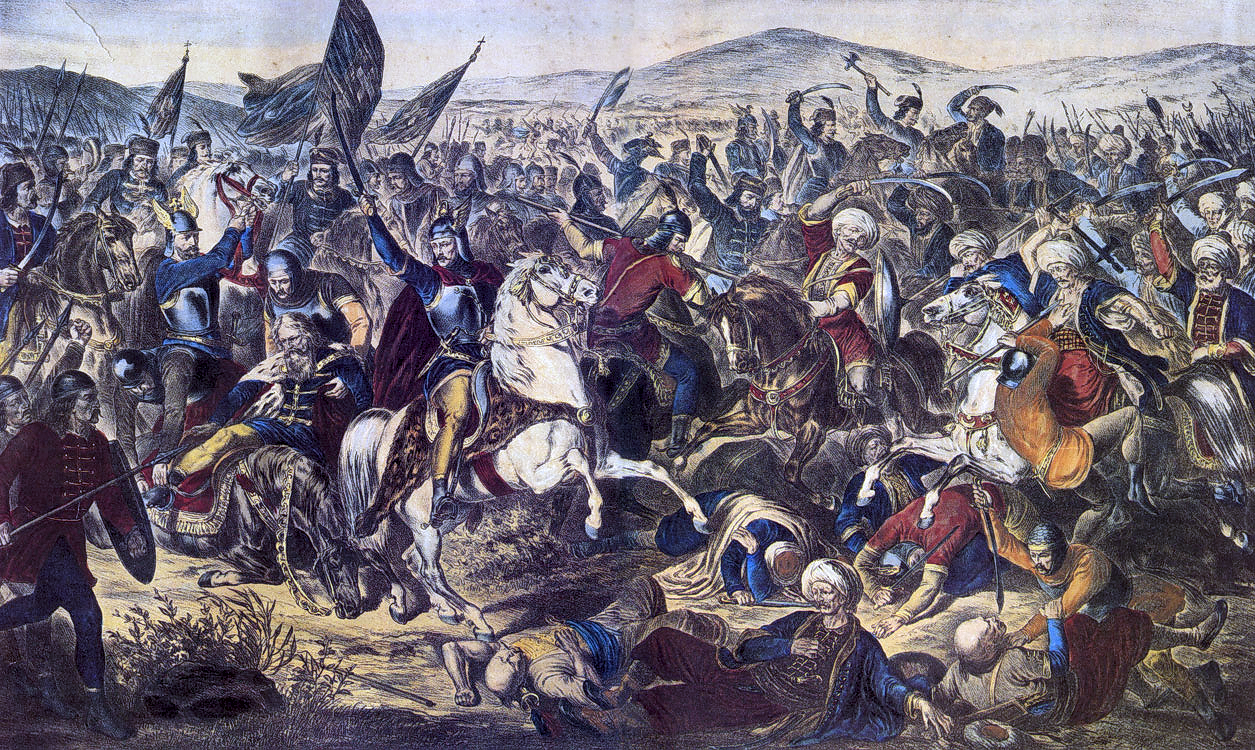
Few reputations in the Serbian past have proven as durable, or as poorly grounded in evidence, as the treason of Vuk Branković. In the epic tradition codified in the nineteenth century, the defeat on the field of Kosovo on June 28, 1389, is explained not as a military outcome but as a moral one: Prince Lazar Hrebeljanović chose the heavenly kingdom over the earthly, the knight Miloš Obilić redeemed Serbian honor by killing Sultan Murad, and Lazar's son-in-law, Vuk Branković, withdrew his forces at the decisive moment and so delivered the Serbs to the Ottomans. The three motifs of sacrifice, heroism, and betrayal have structured the Kosovo legend for centuries. The difficulty, recognized across modern historiography, is that the third of them has no support in any source contemporary with the battle.
The purpose of what follows is twofold. The first is to set the betrayal legend against the documentary record of Vuk Branković's career, which points in the opposite direction from the charge. The second is to reconsider the relative weight assigned to 1389 and to an earlier engagement, the Battle of the Maritsa of 1371, which a substantial body of scholarship regards as the more consequential turning point in the dissolution of medieval Serbian power. The two questions are connected. The disproportion between the historical significance of the Maritsa and its near-total absence from popular memory is, in a sense, the same phenomenon that produced the traitor of Kosovo: the tendency of collective memory to organize a diffuse catastrophe around a single, legible, and morally satisfying event.
I. The man and his realm
Vuk Branković was born around 1345 into a family that had held prominent rank in the Serbian polity for at least three generations. His grandfather, Mladen, served as county lord (župan) under King Stefan Milutin and as duke (vojvoda) under Stefan Dečanski. His father, Branko Mladenović, received the elevated Byzantine court title of sevastokrator from Emperor Stefan Dušan and governed Ohrid. The house was thus embedded in the administrative and military elite of the Nemanjić state at its fourteenth-century height, and later chronicle traditions, whatever their reliability, sought to link the Brankovići by descent to the Nemanjić dynasty itself.
Following the fragmentation of the Serbian Empire after Dušan's death in 1355, Vuk consolidated an extensive lordship. At its greatest extent it reached from Sjenica in the west to the vicinity of Skopje in the east, encompassing the whole of Kosovo, parts of present-day southwestern Serbia, northern North Macedonia, and northern Montenegro, and it drew its wealth from the mining centers of Trepča, Janjevo, and Novo Brdo's hinterland. Contemporaries referred to the territory simply as Vuk's land (Vukova zemlja), administered from Priština and Vučitrn. He bore the title gospodin, lord. His marriage in 1371 to Mara, daughter of Prince Lazar, both allied him to the most powerful of the successor magnates and formally subordinated him to Lazar as his senior. He was, in short, one of the two or three most important Serbian lords of his generation, and by virtue of geography his lordship in central Kosovo lay directly in the path of Ottoman northward expansion.
The year of that marriage was also the year of the catastrophe that historians increasingly identify as the true watershed.
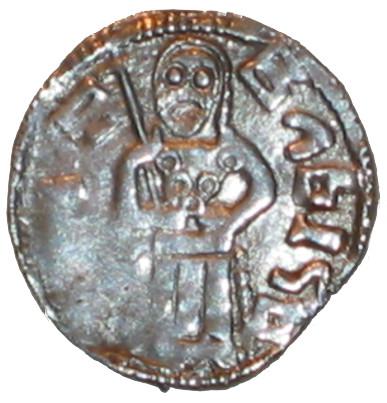
Coin of Vuk Branković, Wikimedia Commons, CC BY-SA 3.0.
II. The Maritsa, 1371
On September 26, 1371, a coalition led by King Vukašin Mrnjavčević and his brother, the Despot Jovan Uglješa, ruler of Serres, confronted an Ottoman force near the Maritsa River at Chernomen, roughly twenty miles west of Adrianople. Uglješa, whose lands lay most exposed to the Ottoman advance out of Thrace, had for some years grasped the scale of the threat. The Ottomans had crossed into Europe at Gallipoli in the mid-1350s and by 1369 had taken Adrianople itself, establishing frontier commands under men such as Lala Şahin Pasha. Uglješa attempted to organize a broad Christian coalition, seeking Byzantine and Bulgarian participation, but these efforts failed, and in the end only his brother joined him. Judging that Ottoman strength in the region was thin while Sultan Murad campaigned in Asia Minor, the brothers advanced across the Thracian plain in what appears to have been an attempt to strike at Adrianople directly.
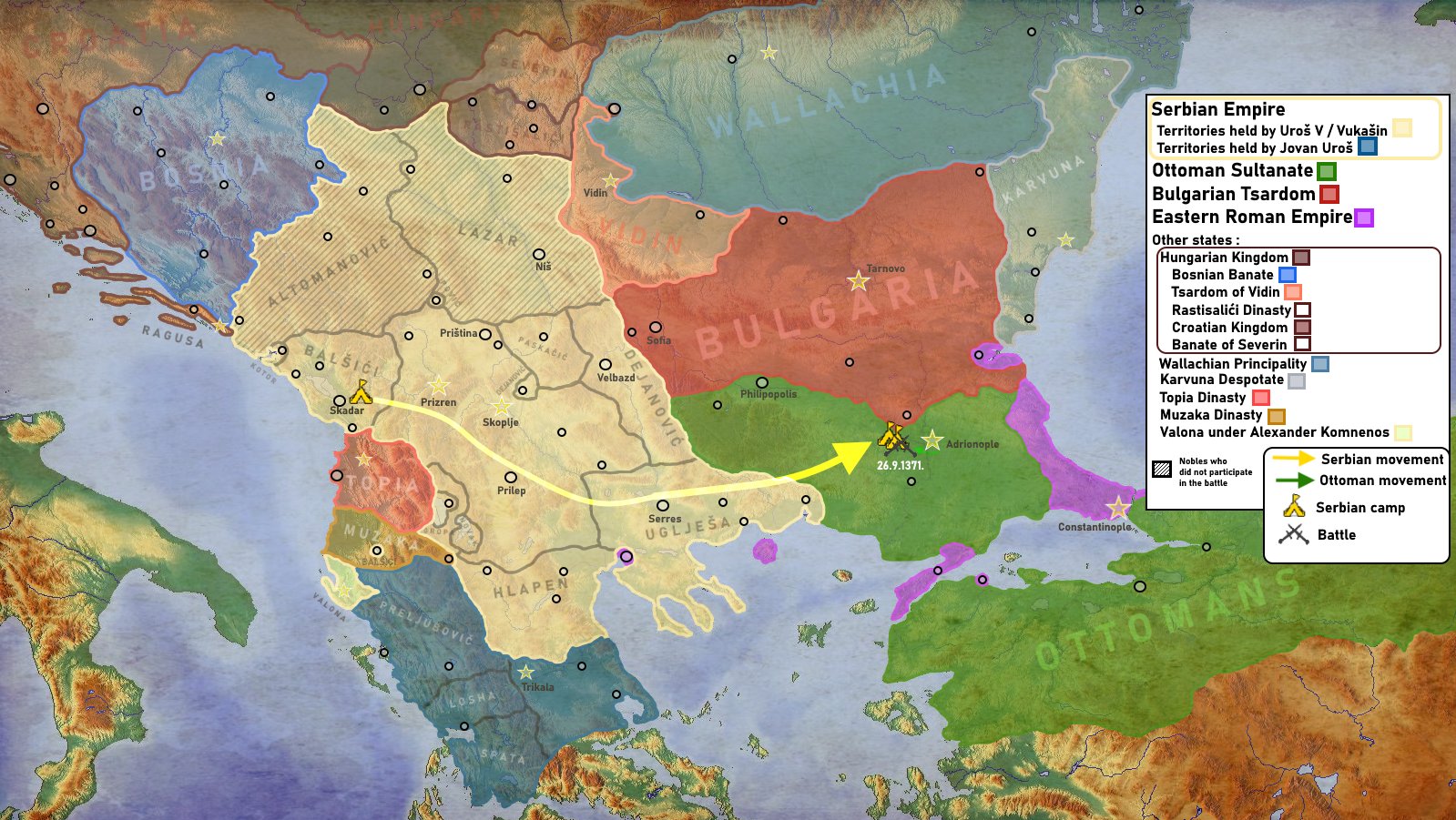
Battle of Maritsa map, Wikimedia Commons, CC BY-SA 4.0.
The result was a disaster whose details remain partly obscure. The best-attested tradition holds that Ottoman forces, a provincial rather than an imperial army, fell upon the Serbian camp at night and destroyed it, killing both Vukašin and Uglješa. The engagement is poorly documented by contemporary sources, and the numbers transmitted by later writers are unreliable: the fourteenth-century Serbian Monk Isaiah's figure of sixty thousand Serbs is generally treated as rhetorical, and Aleksandar Šopov has argued that the forces involved most probably numbered no more than several thousand on either side. Some Ottomanists, including Abdülkadir Özcan, have questioned the standard account of a surprise night raid, and Donald Nicol observed that it is difficult even to characterize the encounter as a conventional Ottoman victory in the field. What is not in dispute is the outcome. The coalition was annihilated and its leaders killed, and the Byzantinist scholarship, drawing on Jireček, preserved the memory of slaughter so extensive that the river was said to have run red.
The consequences were structural rather than merely military. The Mrnjavčević state in the south disintegrated, and over the following years its surviving rulers, including Vukašin's son, the Prince Marko of later legend, together with lords such as Konstantin Dejanović (whose vassalage was first assumed by his elder brother, Jovan Dragaš, around 1373), accepted Ottoman vassalage, with its obligations of tribute and military service. In the same year, Emperor Stefan Uroš V died without heir, extinguishing the Nemanjić dynasty that had ruled the Serbs since the late twelfth century. The combination is worth pausing over. Within a matter of months, the largest organized Serbian military effort of the period was destroyed, two of its foremost rulers were killed, and the legitimate dynasty came to an end. What survived was not a state but a constellation of principalities, among them those of the Balšići, of Prince Lazar in the Morava basin, and of the Brankovići in Kosovo. It was the Maritsa, in this reading, that opened Macedonia and the central Balkans to Ottoman penetration and established the pattern of fragmentation and vassalage that would define the following century.
Seen in this light, Kosovo in 1389 was less the beginning of the Serbian collapse than one of its later episodes. The coalition Lazar assembled existed only because the Maritsa had already removed the rulers who preceded him and reduced the southern lands to tributary status. The historiographical case that the Maritsa was the more decisive engagement rests on precisely this point: 1371 altered the political architecture of the Serbian lands, whereas 1389, whatever its symbolic magnitude, largely confirmed a trajectory already established.
III. Kosovo, 1389
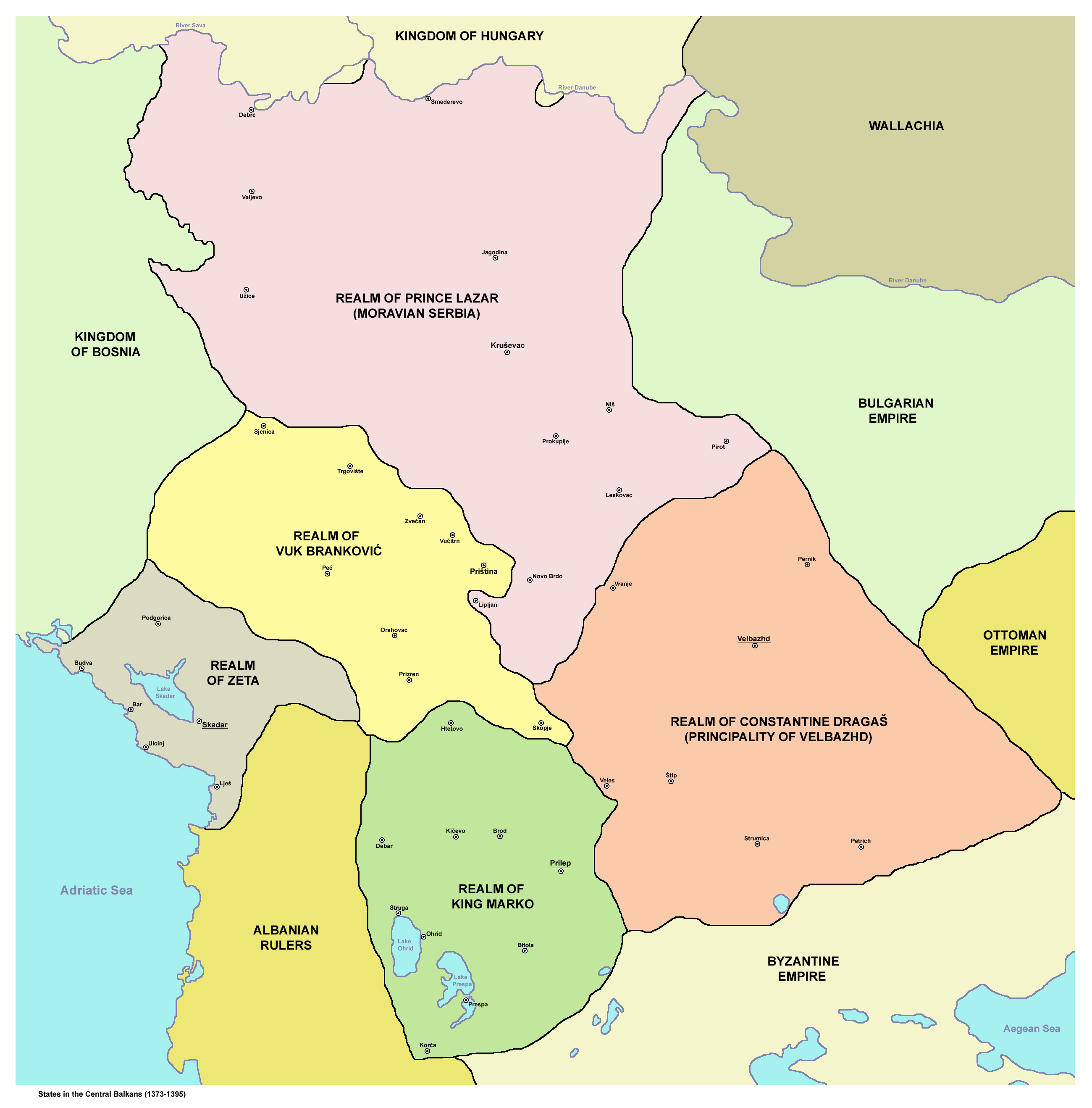
The Serbian lands after the Maritsa: a constellation of principalities in place of the fallen empire, 1373–1395. Wikimedia Commons, public domain.
By 1389 the Ottomans, having secured the southern lords, moved against the northern principalities, and in particular against the heartland of Vuk Branković's realm in central Kosovo. The battle fought there on June 28 is described in the earliest sources in terms very different from those of the later epic. Sultan Murad was killed, most probably by a Serbian knight whom tradition would name Miloš Obilić, an event without close parallel in the Ottoman experience of the period. Prince Lazar was captured and put to death. The engagement was severe enough, and its immediate outcome ambiguous enough, that early reports circulating in Christian Europe initially represented it as a Serbian victory.
Vuk Branković commanded a substantial portion of the Christian army, alongside Lazar and a contingent dispatched by King Tvrtko I of Bosnia. He survived the battle and withdrew with his forces intact. This is the entirety of the factual basis on which the later charge of treason was constructed. It is essential to be precise about what the survival does and does not establish. It establishes that Vuk lived while Lazar died. It establishes nothing about a prearranged withdrawal, a secret understanding with the Ottomans, or a deliberate abandonment of the field, none of which is attested in any source of the period.
IV. The career after Kosovo
The conduct of Vuk Branković in the years following 1389 is difficult to reconcile with the legend, and it is here that the documentary record most directly contradicts the epic. Where Lazar's own principality accepted Ottoman vassalage in 1390–91, negotiated by his widow, Princess Milica, acting as regent for the underage Stefan Lazarević, and where Prince Marko and Konstantin Dejanović likewise entered the sultan's service, Vuk declined. He refused submission and entered into negotiations with King Sigismund of Hungary toward a common anti-Ottoman front, styling himself in that correspondence lord of the Serbs.
The resistance was ultimately unsustainable. In 1392 the Ottomans took Skopje and compelled Vuk into vassalage and the payment of tribute. Yet even in vassalage his posture remained obstructive rather than compliant. He did not appear at the Battle of Rovine in 1395, where Prince Marko and Konstantin Dejanović fought and died in Ottoman service, nor at Nicopolis in 1396, where Stefan Lazarević fought for the sultan and survived. Vuk maintained his contacts with Hungary throughout. The Ottomans resolved the matter by force, seizing his lands in 1395 and 1396 and transferring the greater part of them to Stefan Lazarević. Vuk Branković died in Ottoman captivity, most probably in 1397.
The record therefore admits a straightforward observation. Among the major Serbian lords of the Kosovo generation, the one who resisted the Ottomans most persistently, who refused their vassalage longest, who declined to serve in their armies, and who died their prisoner, is the one whom tradition designates the traitor. The lords who accepted vassalage most readily are, in several cases, the ones tradition remembers with honor. The paradox is not incidental. It is central to any historical assessment of the legend.
V. The formation of the legend
The chronology of the accusation is itself the strongest argument against it. No source contemporary with the battle, whether Serbian, Byzantine, or Ottoman, charges Vuk Branković with betrayal, defection, or collusion. The earliest surviving account to associate him with treachery is the memoir of the Serbian janissary Konstantin Mihailović, written toward the close of the fifteenth century, more than a hundred years after the event, and it is also Mihailović who first names the assassin, rendered there as Miloš Kobila, the form from which the later Obilić derives. The developed form of the legend belongs to the seventeenth century. In his Il regno degli Slavi of 1601, the Ragusan chronicler Mavro Orbini was the first to present Vuk unambiguously as the traitor of Kosovo, and the first to transmit the story of a quarrel between Lazar's daughters over the relative valor of their husbands, from which the epic later derived Vuk's supposed motive of envy and his slander of Miloš. The tradition passed thence into oral circulation and received its authoritative and enduring form in the nineteenth century, when Vuk Karadžić assembled the poems of the so-called Kosovo cycle.
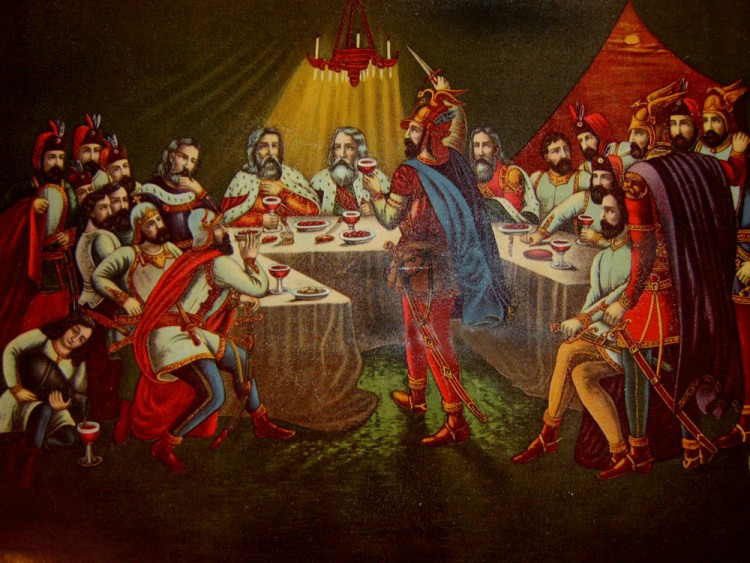
Adam Stefanović, "Kneževa večera" ("The Prince's Supper," 1871). Wikimedia Commons, public domain.
The persistence of the charge across four centuries, in the face of its evidentiary weakness, invites explanation in terms of function rather than fact. A defeat of the magnitude attributed to Kosovo demands an accounting, and a defeat produced by treachery is easier to bear than one produced by the superior organization and resources of the adversary. If the Serbs fell because they were betrayed, they were not truly defeated but sold, and the honor of the cause remains intact. The betrayal motif converts a military reversal into a moral drama, and the drama requires a traitor. That the role should have fallen to Vuk Branković is intelligible on several grounds: he survived when Lazar did not; his descendants would rule Serbia as despots, giving later generations reason to construct a genealogy of guilt and redemption; and the transfer of his lands to the Lazarević line supplied an obvious narrative of just dispossession. The legend, in other words, did work that the historical record could not, and it is the work rather than the evidence that accounts for its endurance.
VI. The scholarly assessment
Modern Serbian historiography has largely rejected the betrayal as unhistorical. Sima Ćirković, Rade Mihaljčić, and Dušan Bataković, among others, have treated it as an apocryphal accretion of the epic tradition rather than a datum of the fourteenth century. The judgment is not unanimous, and honesty requires that the dissent be represented accurately. Momčilo Spremić, weighing the whole of Vuk's career rather than the folk narrative, has argued that a betrayal at Kosovo cannot be declared impossible, and he grounds that qualified conclusion in the documentary sources rather than in the epic. It should be stressed that Spremić claims no more than possibility, and that his position is a caution against overconfidence rather than an endorsement of the legend. Set against a career of documented and costly resistance, the possibility he preserves falls well short of the certainty the tradition asserts.
The larger conclusion concerns the relation between significance and memory. The Battle of the Maritsa ended a dynasty, destroyed the principal Serbian military force of its generation, and opened the central Balkans to Ottoman advance; it has left almost no trace in popular memory. The Battle of Kosovo, closer to a stalemate in its immediate result and less consequential in its structural effects, became the organizing event of Serbian national consciousness, and it did so in part by acquiring the moral apparatus that history had denied it, including a traitor to explain the loss. The distance between the two battles, in the record and in memory, is the same distance that separates the historical Vuk Branković from the figure of the epic. Recovering the first from the second is among the more instructive exercises the medieval Serbian past affords.
Sources and Further Reading
- Sima Ćirković, The Serbs (Blackwell, 2004).
- John V. A. Fine, The Late Medieval Balkans: A Critical Survey from the Late Twelfth Century to the Ottoman Conquest (University of Michigan Press, 1994).
- Rade Mihaljčić, The Battle of Kosovo in History and in Popular Tradition (BIGZ, 1989).
- Donald M. Nicol, The Last Centuries of Byzantium, 1261–1453 (Cambridge University Press, 1993).
- Momčilo Spremić, "Branković in History and Tradition," in Prekinut uspon: srpske zemlje u poznom srednjem veku (Belgrade, 2005).
- Aleksandar Šopov, The Historical Visions of the Battle of the Maritsa / Meriç (MA thesis, Sabancı University, 2007).
- Konstantin Jireček, Istorija Srba, trans. and ed. Jovan Radonić, 2 vols. (Belgrade: Naučna knjiga, 1952).
- Konstantin Mihailović, Memoirs of a Janissary, trans. Benjamin Stolz, historical commentary by Svat Soucek, Michigan Slavic Translations No. 3 (Ann Arbor: University of Michigan, 1975).
- Mavro Orbini, Il regno de gli Slavi (Pesaro: Girolamo Concordia, 1601).
- Dušan T. Bataković, The Kosovo Chronicles (Belgrade: Plato, 1992).
- Abdülkadir Özcan, "Hacı İlbey," TDV İslâm Ansiklopedisi (Istanbul: Türkiye Diyanet Vakfı, 1996).