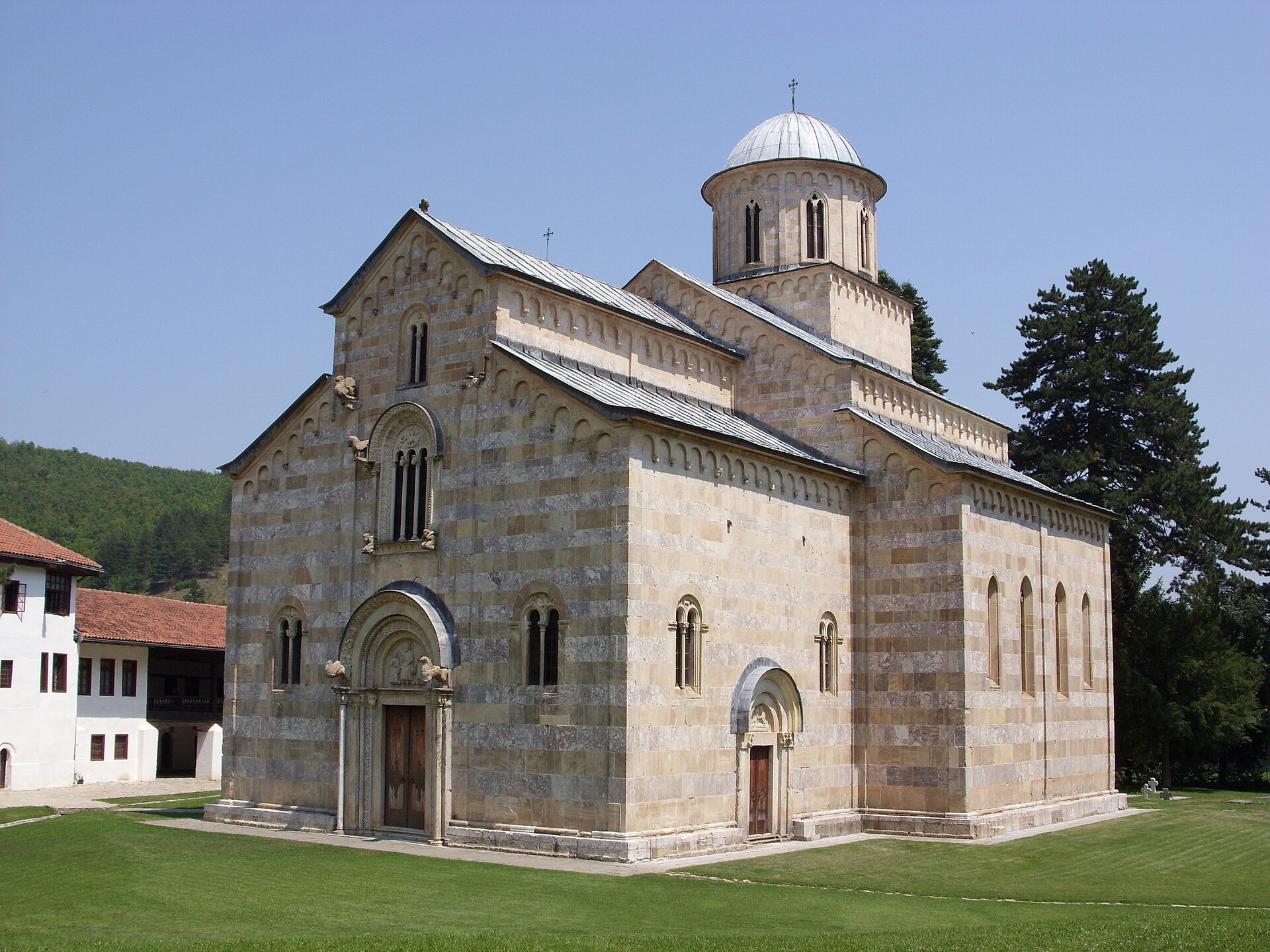
A thesis has circulated for years in parts of the Albanian-language public sphere, and it resurfaces with some regularity: that the great medieval monuments of Kosovo and Metohija, the monastery of Visoki Dečani, the Patriarchate of Peć, Gračanica, and Our Lady of Ljeviš, were not Serbian foundations at all. On this account they were originally "Illyrian-Arbër" Catholic churches, built by and for an autochthonous Albanian population, and only later usurped, overwritten, and rebranded by Serbs. The conclusion drawn is that the monuments "are no evidence of Serbian culture," and that the Serbian Orthodox Church holds them illegitimately.
The claim is testable. The monuments come with an unusually rich documentary apparatus: founding charters that survive on parchment, dated ktetorial inscriptions on the walls, fresco programs whose content is dynastic and legible, a builder's inscription naming the architect and his patron, and a century of peer-reviewed art history and philology. This essay sets the thesis against that record.
I. The thesis in its fullest form
The most complete recent statement of the claim came from the historian Bedri Muhadri, in a two-part article published in the Pristina daily Koha Ditore on 12 and 19 September 2020, under a title announcing the "appropriation by Serbs of medieval Arberian monuments in Kosovo."
Muhadri's argument, as summarized by one of his critics, ran through seven propositions: that all the monuments were built on earlier foundations; that those foundations were Illyrian-Arberian and Catholic; that Kosovo's Albanians were at the time Catholics; that Serbs "had no traditions in construction"; that the monuments were therefore built by non-Serbs; that a "Catholic Albanian priest" from Kotor designed Dečani; and that Albanian clans protected the monuments through the centuries because the monuments had been their own. From these propositions Muhadri concluded that the monuments were usurped and are no evidence of Serbian culture.
Each proposition can be examined against a source. Most collapse on contact.
II. What the founding charter records
The single most direct piece of evidence is a tax document. In 1330, King Stefan Uroš III, known as Stefan Dečanski, endowed his rising monastery of Visoki Dečani with an estate, and the grant was recorded in the Dečani Chrysobull, a charter that survives in three parchment versions from the first half of the fourteenth century. The first version is a scroll five metres long, written at the royal residence at Nerodimlja in southern Kosovo, signed by the king in red ink. The critical scholarly edition was published by the linguists Pavle Ivić and Milica Grković in Novi Sad in 1976; Grković later produced an authorized bilingual edition in 2004.
The charter is not a work of ideology. It is an enumeration of taxpayers: 2,097 dependent farming households, 266 Vlach pastoralist households, and 69 households of sokalnici, listed by personal name, village by village, across the estate lands in Metohija and beyond.
Grković's onomastic analysis of those names found that roughly ninety percent of the personal names in the estate villages were Slavic. In her 2004 edition she wrote that "a population was living which had about 90% of Serbian names of Slavic origin. Such a high percentage testifies to the fact that the settlements were inhabited by Serbs. From the overall picture, the exceptions are the katun of the Arbanas, the village Greva in Altin, and Kusevo in Zeta." Three settlements out of the entire estate, one Albanian pastoral katun and two villages, showed Albanian anthroponymy. Of the more than five hundred toponyms recorded in the charter, Grković found exactly one of Albanian origin, and observed that this "indicates that the Albanian population did not live there before the fourteenth century."
It should be said that inflated versions of these figures circulate in polemical outlets, quoting precise-sounding percentages that cannot be traced to any peer-reviewed page. The figures given here are Grković's own, from her published editions of 1976, 1986, and 2004, and the household totals are corroborated in John V. A. Fine's standard history The Late Medieval Balkans.
A fourteenth-century royal chancery had no conceivable motive to falsify the ethnic texture of its own tax rolls; the charter's purpose was revenue, not posterity. The record it left is of a densely Slavic-named population with a small, specifically noted Albanian presence. That is the ground on which the Dečani monastery was founded.
III. What the walls say
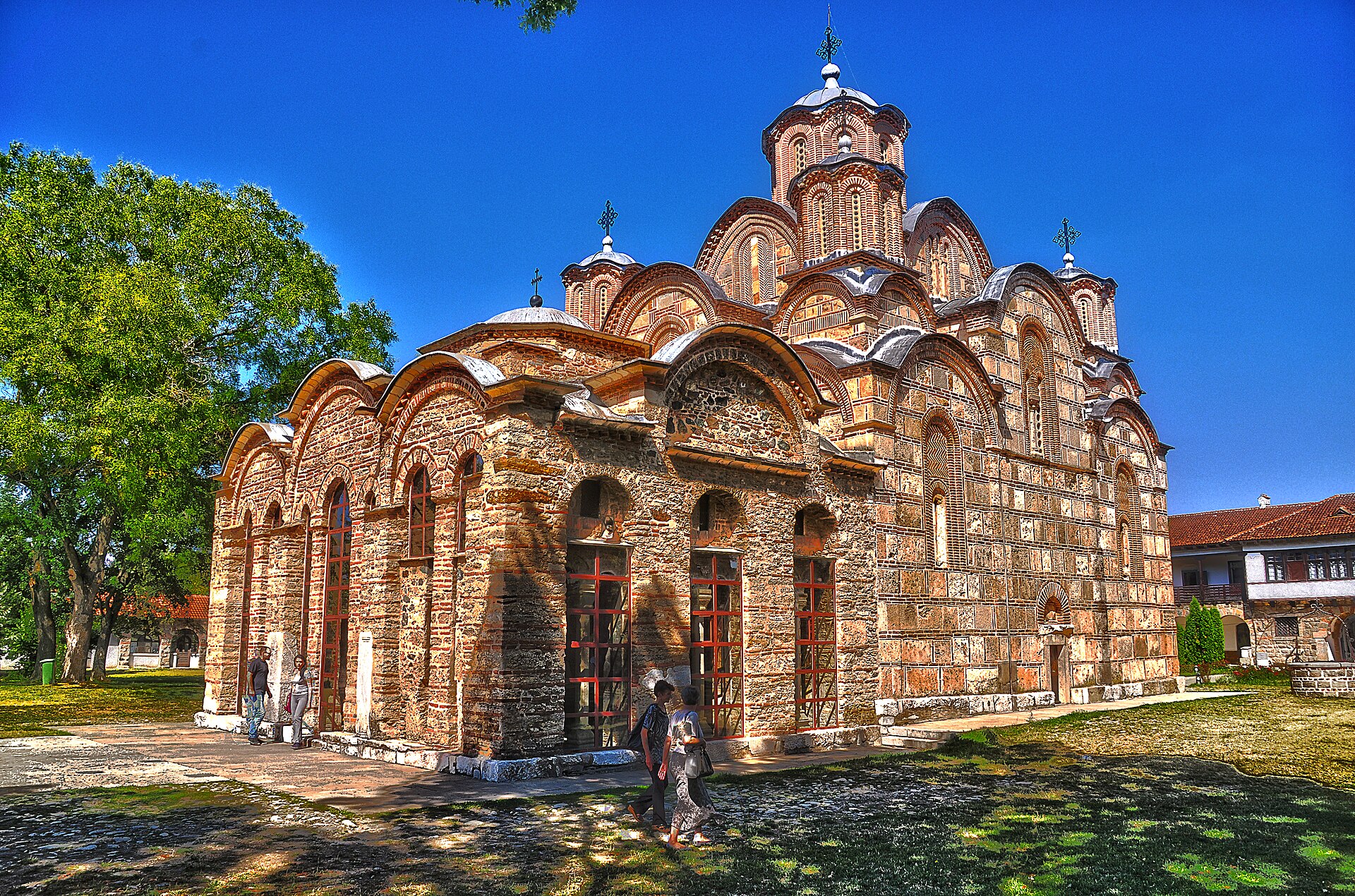
Gračanica, built from the ground by King Milutin by 1321. Photo: Saša Micić, Wikimedia Commons, CC BY-SA 3.0.
The frescoes make the same point in paint. At Gračanica, King Milutin's ktetorial inscription of 1321 survives on the southern wall: "I have seen the ruins and the decay of the Holy Virgin's temple of Gračanica, the bishopric of Lipljan, so I have built it from the ground and painted and decorated it both from inside and outside." The inscription is in Old Church Slavonic, the liturgical language of the Serbian church, and it names the church's function within the Serbian ecclesiastical structure, the bishopric of Lipljan.
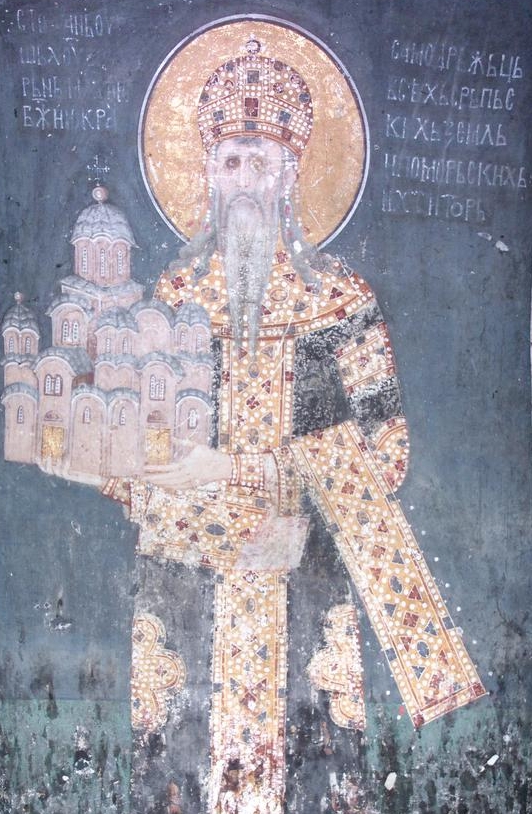
King Milutin holding the model of his church, ktetor fresco, Gračanica, c. 1321. Wikimedia Commons, public domain.
In the same church, on the eastern wall of the narthex, appears the earliest known instance in Serbian monumental painting of the Nemanjić dynastic tree: sixteen royal portraits arranged in four rows, entwined in a vine that grows from Stefan Nemanja as the root, deliberately modelled on the Tree of Jesse, the genealogy of Christ. The program was studied definitively by Slobodan Ćurčić, whose 1979 Penn State monograph on Gračanica remains the standard work, and by Branislav Todić in his studies of the painting of Milutin's age. The same dynastic tree recurs at the Patriarchate of Peć and at Dečani.
The point matters because it forecloses the "generic older church" argument. These fresco programs are not devotionally neutral surfaces onto which any ethnicity might later be projected. Their explicit content is the legitimacy of a specific Serbian royal house, painted at the moment of construction, in the dynasty's own commission. A church whose walls narrate the genealogy of the Nemanjići, in Slavonic, for a Serbian king named in the founding inscription, is not a building whose authorship is up for grabs.
The institutional history runs parallel. The seat of the Serbian archbishopric moved from Žiča to Peć in the thirteenth century, and in 1346, at the state-church assembly in Skopje, Stefan Dušan raised it to the rank of the Serbian Patriarchate of Peć. The buildings and the institution they housed grew together.
IV. Fra Vita of Kotor
One genuine fact sits at the center of the usurpation thesis, and it is instructive to watch what the thesis does with it. Above the south doorway of the Dečani katholikon, an inscription records the builder: "Fra Vita, a Friar Minor, master builder from Kotor, the royal city, built this church of the Holy Pantokrator for the lord King Stefan Uroš III and his son, the majestic and very great and very glorious lord King Stefan."
Fra Vita was a Franciscan, a Catholic, from the Adriatic coast. From this the thesis derives a "Catholic Albanian priest" and, from him, Albanian authorship of the monument.
The inscription itself refutes the inference. Kotor is named as "the royal city" because it was a city of the medieval Serbian kingdom, and Fra Vita states in stone that he built the church for the Serbian king. Construction ran from 1327 to 1335, supervised by the Serbian archbishop Danilo II. The ICOMOS evaluation prepared for UNESCO describes Dečani as an Orthodox construction built by Catholic craftsmen from the Dalmatian coastal region, which was the normal pattern of Adriatic craftsmanship in Serbian royal service; Ćurčić's 2010 Yale survey of Balkan architecture places Dečani within a continuous Serbian architectural tradition running from twelfth-century Studenica through the Raška-school royal mausolea.
The economist and author Andrea Lorenzo Capussela put the analogy plainly: the Winter Palace in St Petersburg and parts of the Kremlin were designed by Italian architects, and are no less Russian for that.
V. The autochthony claim and the scholarship
Beneath the specific propositions lies the broader premise: that Albanians, as descendants of the Illyrians, are the autochthonous population of Kosovo, and that whatever stands on the land is therefore originally theirs.
The scholarly literature does not carry this weight. Noel Malcolm, whose Kosovo: A Short History is broadly sympathetic to the Albanian national narrative, treats the Illyrian and Thracian origin theories as tentative and explicitly declines to overstate the linguistic evidence. The documentary record places the Albanian ethnonym and language considerably later than the autochthony premise requires: the first appearance of Albanians under their own name comes in the History of the Byzantine writer Michael Attaleiates, composed around 1079, describing their participation in a revolt in the region of Dyrrhachium; the first attestation of the Albanian language anywhere is a Ragusan witness statement of 1284 or 1285, recording that "I heard a voice crying in the mountains in the Albanian language." None of this settles the genuinely open question of Albanian ethnogenesis, and this essay does not pretend that it does. What it establishes is narrower and sufficient: there is no evidentiary path from the open question of Illyrian continuity to the specific claim that fourteenth-century Serbian royal foundations were pre-existing Albanian Catholic churches.
Scholars who study the region's identity politics treat autochthony arguments as a genre rather than a finding. Anna Di Lellio's study of the Albanian epic of the 1389 battle analyzes the Albanian counter-narrative of Kosovo as itself a nationalist myth, constructed in the twentieth century to underwrite an indigeneity claim. Ger Duijzings' Religion and the Politics of Identity in Kosovo documents how thoroughly religion and origin stories have been pressed into the service of that narrative.
VI. A rebuttal from an unexpected quarter
The most telling response to Muhadri's articles came not from a Serbian institution but from a scholar publicly committed to Kosovo's statehood. Andrea Lorenzo Capussela led the economics unit of Kosovo's International Civilian Office and is the author of State-Building in Kosovo, published by I.B. Tauris in 2015; he has written that Kosovo's independence is irreversible. On 28 September 2020, in the portal European Western Balkans, he published a point-by-point critique of the Koha Ditore articles under the title "Are 'Serb' churches Serb? Critique of an unwise choice."
Capussela found no indication that Dečani or the Patriarchate church at Peć were built on earlier churches at all. He noted that where earlier structures are documented, at Gračanica and Ljeviš, nothing identifies them as Albanian or Catholic, and that the pre-schism dating makes the equation of "older building" with "Catholic-Albanian building" unsupportable in any case. Against the proposition that Serbs had no building traditions, he pointed to Studenica and Sopoćani, built by Serbian rulers in the decades before Dečani. The usurpation charge he judged anachronistic, a projection of modern national categories onto a medieval world that did not contain them.
His conclusion was unambiguous: "To say that they 'are no evidence of Serb culture' is visibly, tangibly wrong... But the dominant hue, manifestly, is Serb. Both of Dr Muhadri's main conclusions are untenable."
VII. The record of destruction
The contest over these monuments has not been confined to newspaper columns. The empirical record of what happened to them between 1998 and 2004 was established by scholars with no stake in Serbian claims: András Riedlmayer of Harvard, who documented the destruction of Islamic heritage in the same period, and Andrew Herscher, who investigated wartime destruction for the Hague tribunal and later co-directed the culture department of the UN administration in Kosovo. Their October 1999 field survey, and Herscher's subsequent Stanford monograph Violence Taking Place, are the standard sources.
Riedlmayer's finding on the Orthodox monuments bears quoting exactly: "Remarkably, not a single Serb Orthodox church or monastery in Kosovo was damaged or destroyed by Albanians during the 1998-1999 conflict... Following the end of hostilities in June 1999, dozens of Serb Orthodox churches and monasteries were damaged in revenge attacks."
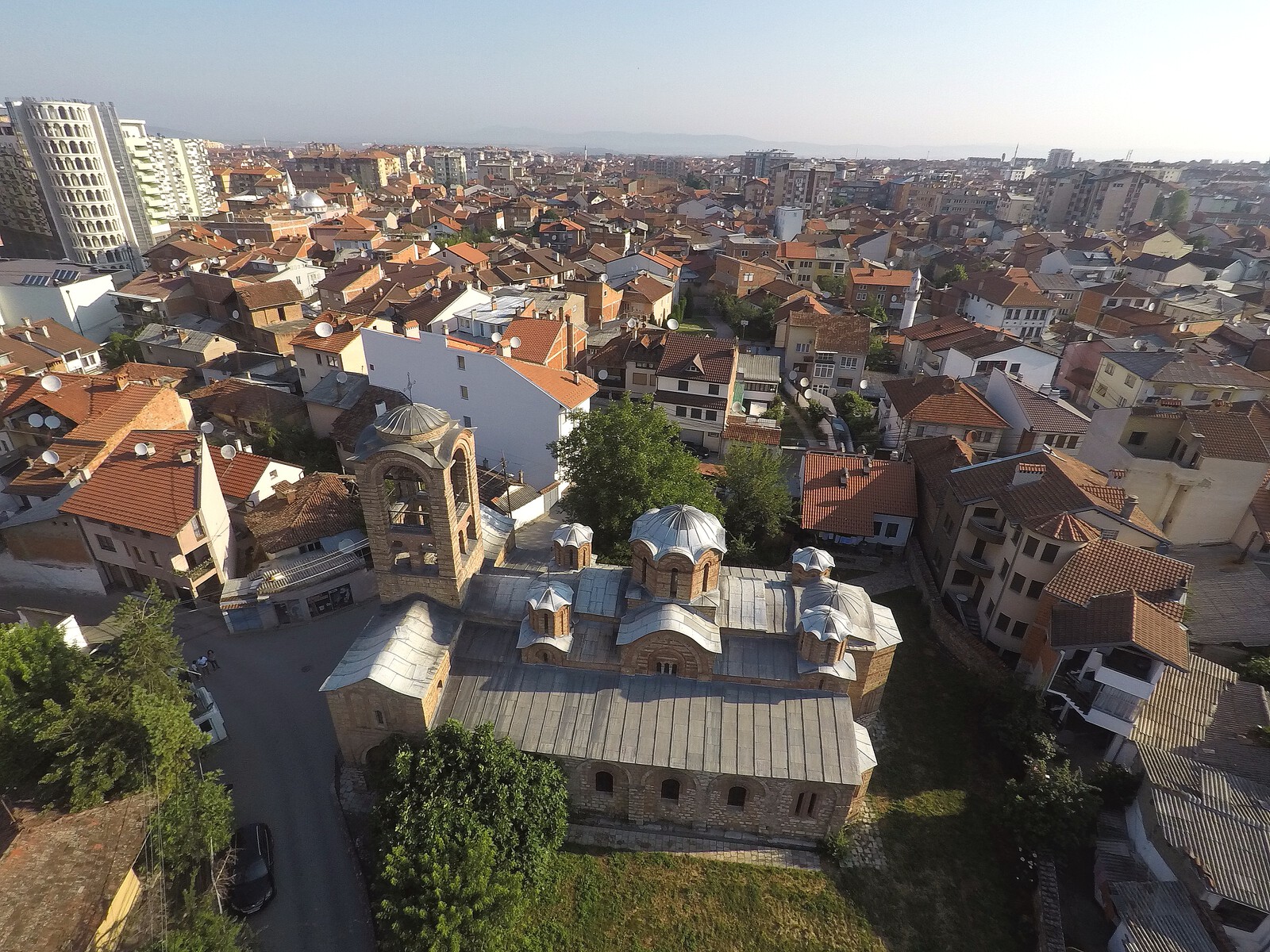
Our Lady of Ljeviš, Prizren, set on fire in the riots of March 2004 and since restored. Photo: BLAGO Fund, Wikimedia Commons, CC BY 4.0.
The International Center for Transitional Justice documented 155 Serbian Orthodox churches and monasteries destroyed by Kosovo Albanians between June 1999 and March 2004. The riots of 17 and 18 March 2004 damaged or destroyed a further 35 churches and monasteries in two days; the Serbian Holy Synod, meeting in extraordinary session on 18 March, reported that all churches of the Serbian Orthodox Church in Prizren had been destroyed and appealed to the European Union, the United States, Russia, and the United Nations to end what it called a pogrom. By Riedlmayer's later account, 143 individuals were eventually convicted for the March violence, 67 of them to prison terms of more than a year, while the organizers were never brought to justice.
The relevance to the origin thesis is structural. Buildings that were, on the thesis, originally Albanian patrimony were destroyed by the hundred in peacetime, after the war had ended. Heritage claimed as one's own is not normally dynamited. The destruction record and the appropriation rhetoric are two instruments of a single contest over whether Serbian presence in Kosovo has a legitimate past, and scholars have said as much: Scott Lackenby's 2024 study in Religion, State and Society analyzes the monasteries as "religious infrastructure," material assets whose custody carries territorial and political weight far beyond the liturgical.
VIII. What the international record says
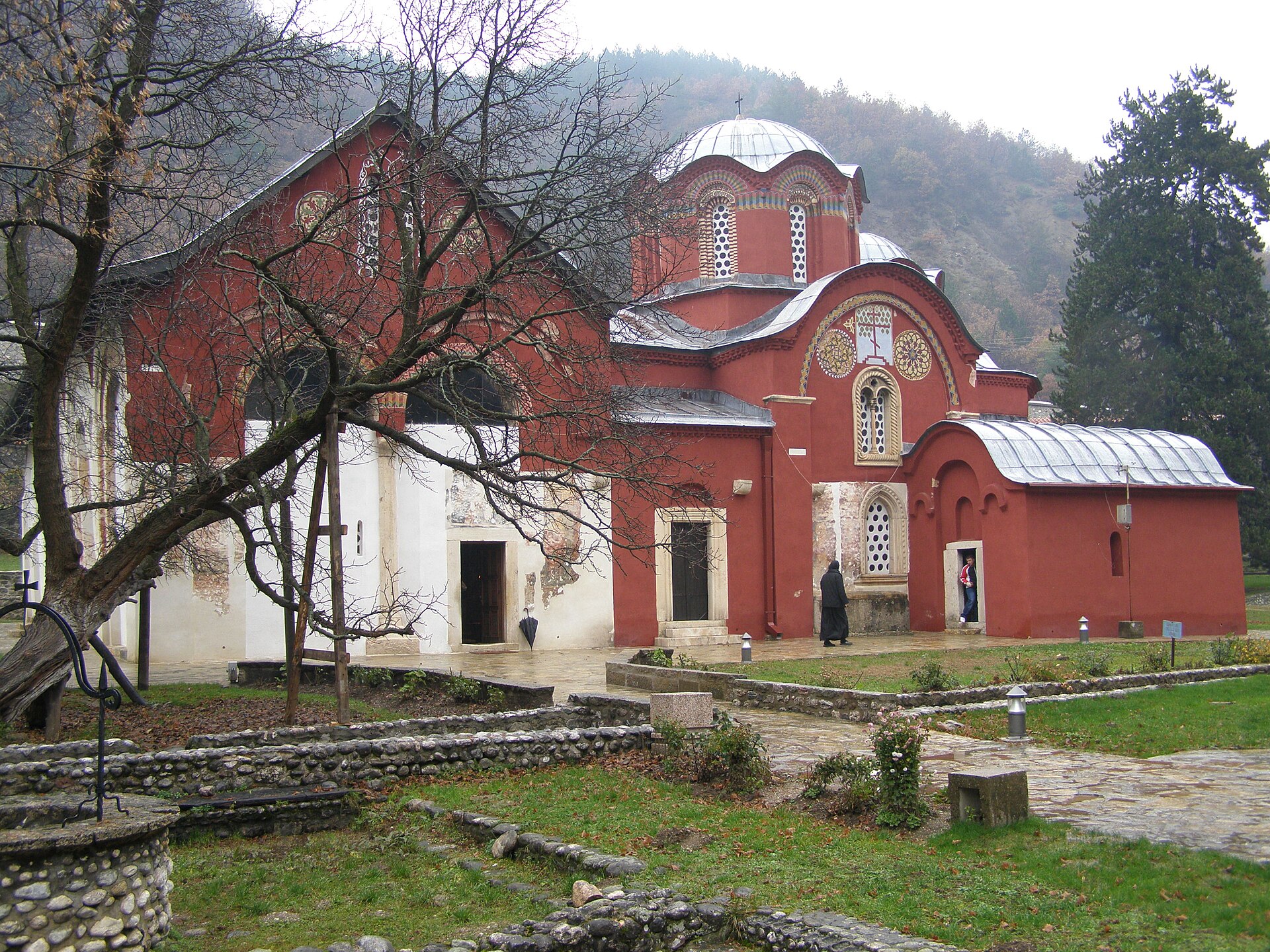
The Patriarchate of Peć, seat of the Serbian church raised to a patriarchate in 1346. Photo: Vanjagenije, Wikimedia Commons, CC BY-SA 3.0.
The international documentary record is consistent with the medieval one. Dečani was inscribed on the UNESCO World Heritage List in 2004; in July 2006 the property was extended to include Gračanica, the Patriarchate of Peć, and Our Lady of Ljeviš under the title "Medieval Monuments in Kosovo," and simultaneously placed on the List of World Heritage in Danger, where it remains. UNESCO's own documentation describes the four edifices as Serbian Orthodox churches and monasteries founded by members of the Nemanjić dynasty. The nomination had been submitted as "Serbian Medieval Monuments in Kosovo"; the national designation was dropped from the title only because UNESCO group nominations do not carry one.
In November 2015, Kosovo's application for UNESCO membership failed by three votes, 92 in favor against the 95 required. In May 2016, Kosovo's own Constitutional Court confirmed the Dečani monastery's ownership of the 24 hectares of land the monastery had claimed, holding the matter finally decided. Kosovo authorities declined to register the ruling for nearly eight years. In March 2024, under pressure connected to Kosovo's Council of Europe accession bid, the government instructed the Cadastral Agency to implement the decision, and the monastery was registered as owner.
IX. The current campaign
The origin thesis has lately acquired a street-level expression. What follows rests on journalistic reporting, principally by BIRN's Balkan Insight, Kosovo Online, and the Kosovo Serb outlet KoSSev, together with the Diocese of Raška and Prizren's own communiqués and the Orthodox Church of Albania's statements; scholarship on these events does not yet exist, and the reader should weigh the sourcing accordingly.
The man behind the campaign is Niko Bllazhde, a citizen of the Republic of Albania from Elbasan, who presents himself under the ecclesiastical name Nikolla Xhufka and the title "father." He claims a theological education. The Orthodox Church of Albania disputes this directly, stating that he in fact completed vocational high school for food technology in Elbasan, repeating the final year, and holds no seminary or theological credential of any kind. He is not ordained, has never been received into clerical rank by any canonical Orthodox jurisdiction, and is not listed among the clergy of the Orthodox Church of Albania or any other local church.
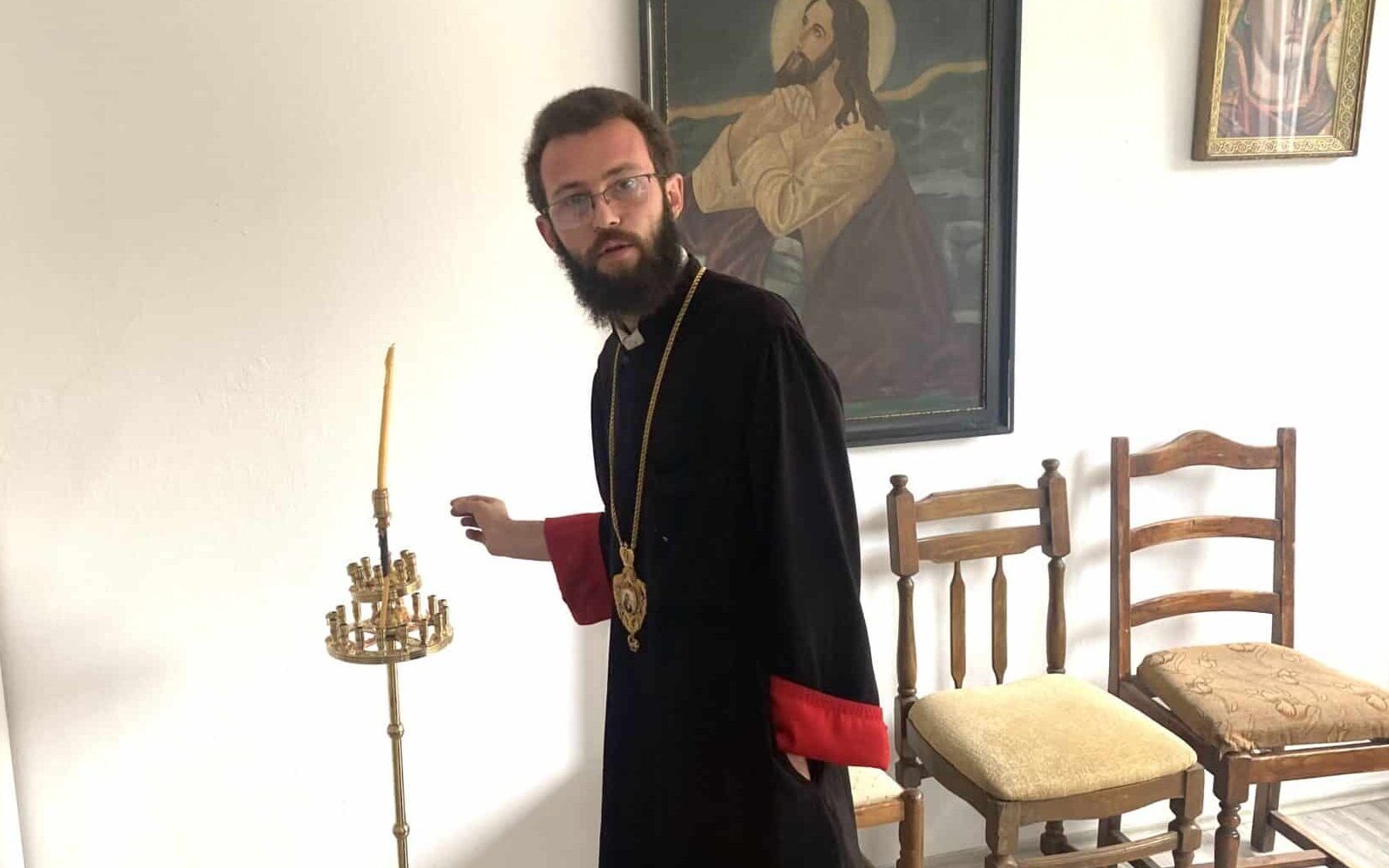
Niko Bllazhde, who presents himself as "Father Nikolla Xhufka." Photo: Balkan Insight / BIRN.
On this foundation Bllazhde has built a series of self-styled ecclesiastical titles. He announced the creation of an "Albanian National Orthodox Church 'Saint Kozma'" based in Elbasan, and separately claims to have established an "Orthodox Church of Kosovo," operating out of a converted former private nursery in downtown Pristina. Neither body is recognized by any canonical Orthodox church, in Albania, Kosovo, or elsewhere.
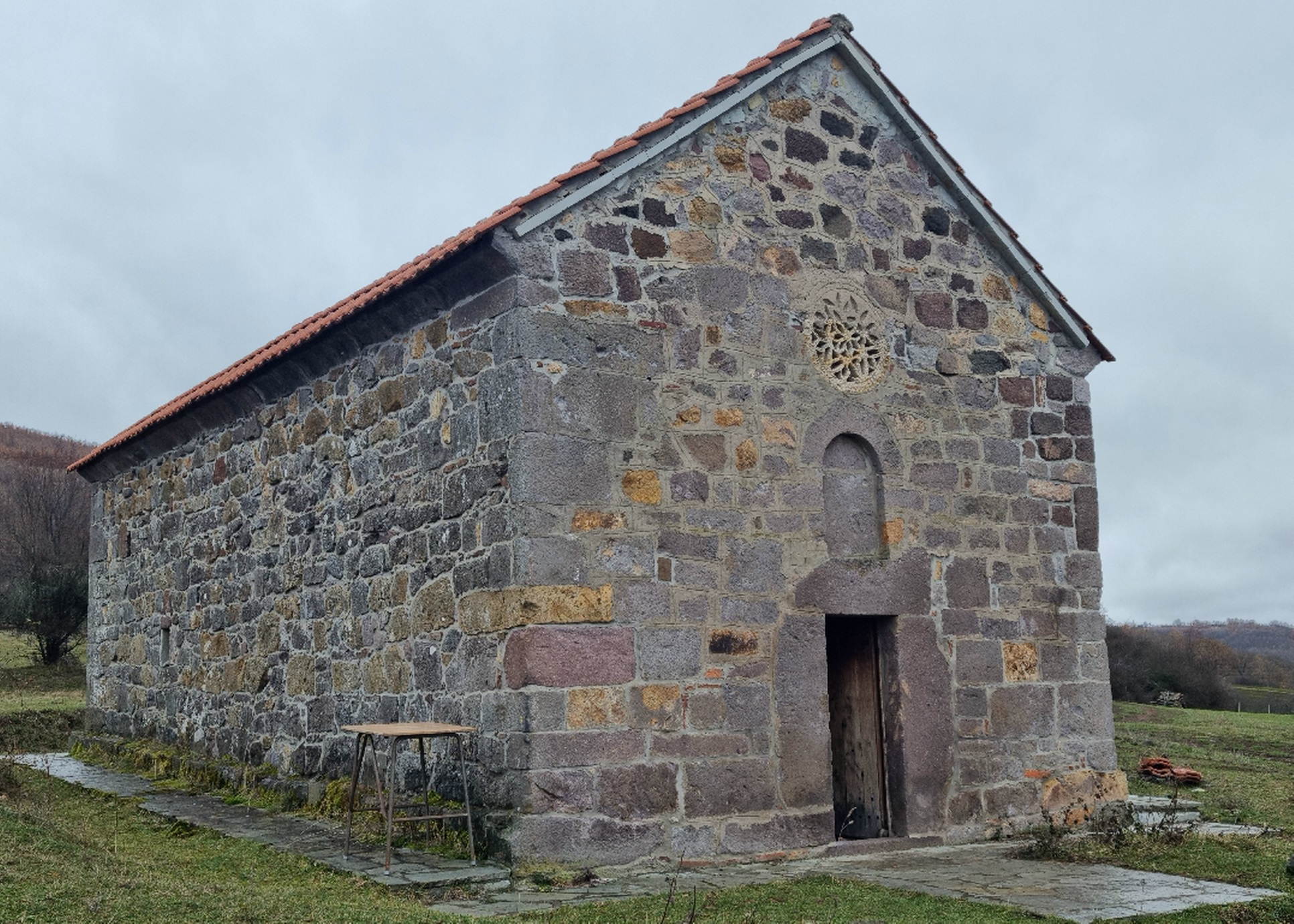
The Church of St Archangel Michael, Rakitnica, photographed shortly after the November 2023 break-in. Photo: Diocese of Raška and Prizren.
On 28 November 2023, Albania's Independence Day, Bllazhde and roughly twenty followers broke into this disused Serbian Orthodox church near Podujevo, a building the surrounding Kosovo Albanian community itself has long called "Lazër's Church," after a local tradition that the body of Prince Lazar rested there overnight following the Battle of Kosovo. Bllazhde declared it renamed for the Albanian bishop Fan Noli and placed it under his self-declared jurisdiction, conducting a service with the Albanian national flag. He has since returned to force entry into the same church on further occasions, prompting the Diocese of Raška and Prizren to file repeated criminal complaints, the third after yet another break-in. In one address delivered in the name of his self-styled church, he warned the Serbian Orthodox Church, Patriarch Porfirije, and the Diocese by name against approaching the building, threatening that they would face "infernal fire, as has been the case throughout history." The OSCE mission in Kosovo has publicly stated its concern over the repeated unauthorized incursions. Kosovo's Special Prosecution announced an indictment in May 2024 against Bllazhde and an associate, Lejdi Zagalli, for inciting national, religious, and ethnic hatred.
The canonical Orthodox Church of Albania has repeatedly disowned him. In statements issued in 2022 and again after the Rakitnica break-in, it said he "is not an Orthodox cleric and is not recognised as such by any Christian Church in any country," calling the affair "simply a case of public deception" and stating plainly that he is "a layman, a self-proclaimed priest," not a member of its clergy under any title. Its spokesman Toma Dima called him "a fraud and a person who is not a priest." The Diocese of Raška and Prizren described the break-ins as part of a series of attempts at usurping the spiritual and cultural heritage of the Serbian Orthodox Church.
The episode is fringe, criminally indicted, and disavowed by Albanian Orthodoxy itself, run by a man with no theological training beyond his own claim to it. It is worth recording precisely because it shows the "original Albanian churches" thesis translated from newsprint into practice, and what that practice looks like.
X. What the evidence permits
An honest accounting states its own limits. The question of Albanian origins, Illyrian continuity or otherwise, is genuinely open in linguistics and archaeology, and nothing here forecloses it. If a peer-reviewed excavation were one day to establish datable pre-fourteenth-century Catholic church structures beneath Dečani or Peć, the first of Muhadri's propositions would require revisiting; to date, no such identification exists. And the scholarship cited throughout, Duijzings, Di Lellio, Herscher, Lackenby, includes no partisan of the Serbian cause; that independence is precisely why their findings carry the weight they do here.
What the evidence permits is nonetheless a firm conclusion on the specific claim. The founding charter of Dečani names its royal founder and enumerates an estate population some ninety percent of whose recorded names were Slavic, with the Albanian presence individually noted at three settlements. The walls of Gračanica carry the Serbian king's own founding inscription and the genealogy of his house. The builder of Dečani names his patron, the Serbian king, in the stone above the door. The scholarship, including scholarship sympathetic to Kosovo's statehood, finds the usurpation thesis untenable. UNESCO's documentation attributes the monuments to the Nemanjić foundation. And the party said to have usurped this heritage is the one that has spent a quarter-century, at the cost of 155 destroyed churches and monasteries, trying to keep it standing.
The monuments were built as Serbian royal and ecclesiastical foundations, they are documented as such in their own charters and on their own walls, and no body of peer-reviewed scholarship says otherwise.
An Editorial Note
This publication has not written about Dečani, Gračanica, Peć, and Ljeviš as antiquities. They are living churches, still consecrated, still prayed in where prayer is still possible, and the record set out above, of charters, frescoes, and inscriptions, sits beside a more recent record: a quarter-century of arson, a pogrom whose organizers were never named, and a man with no theological training and a food-technology diploma installing himself in a stolen church and threatening a Patriarch with hellfire. Orthodox Christians outside the Balkans have the luxury of meeting these monasteries as photographs. The Serbian Orthodox Church meets them as a daily custodial fact, guarded, rebuilt, and, in Dečani's case, litigated for the better part of a decade before a court's own ruling was finally honored.
Justice for that record does not end with scholarship. It is owed as restitution, as prosecution of organizers who have never faced a court, and as the plain right of a people to pray in their own churches undisturbed. Orthodoxy worldwide, and the Serbian people most of all, have a standing obligation to say so, and to keep saying it until the historical record and the practice on the ground finally agree.
Sources and Further Reading
- Pavle Ivić and Milica Grković, Dečanske hrisovulje (Novi Sad: Institut za lingvistiku, 1976).
- Milica Grković, The First Charter of the Dečani Monastery, bilingual edition, trans. Randall A. Major (Belgrade: Mnemosyne / Archive of Serbia, 2004).
- Milica Grković, Rečnik imena Banjskog, Dečanskog i Prizrenskog vlastelinstva u XIV veku (Belgrade: Narodna knjiga, 1986).
- Slobodan Ćurčić, Gračanica: King Milutin's Church and Its Place in Late Byzantine Architecture (Pennsylvania State University Press, 1979).
- Slobodan Ćurčić, Architecture in the Balkans from Diocletian to Süleyman the Magnificent (Yale University Press, 2010).
- Branislav Todić, Serbian Medieval Painting: The Age of King Milutin (Belgrade: Draganić, 1999).
- Milka Čanak-Medić, Le monastère de Dečani: le catholicon (Belgrade, 2007).
- John V. A. Fine, The Late Medieval Balkans (University of Michigan Press, 1994).
- Noel Malcolm, Kosovo: A Short History (New York University Press, 1998).
- Anna Di Lellio, The Battle of Kosovo 1389: An Albanian Epic (Anthem Press, 2009).
- Ger Duijzings, Religion and the Politics of Identity in Kosovo (Hurst, 2000).
- Andrew Herscher, Violence Taking Place: The Architecture of the Kosovo Conflict (Stanford University Press, 2010).
- Andrew Herscher and András Riedlmayer, "Monument and Crime: The Destruction of Historic Architecture in Kosovo," Grey Room 1 (2000); and "Architectural Heritage in Kosovo: A Post-War Report" (Kosovo Cultural Heritage Project, 2000).
- Scott Lackenby, "Have you visited our monasteries? Serbian monastic heritage as religious infrastructure," Religion, State and Society (2024).
- Bishop Maxim (Vasiljević), ed., The Christian Heritage of Kosovo and Metohija (Sebastian Press / Institute for Balkan Studies SASA, 2015).
- Andrea Lorenzo Capussela, "Are 'Serb' churches Serb? Critique of an unwise choice," European Western Balkans, 28 September 2020.
- UNESCO World Heritage Committee, Decisions 30 COM 8B.53 and 8B.54 (2006); ICOMOS Evaluation No. 724.
- Serbian Orthodox Church, Appeal of the Extraordinary Session of the Holy Synod, 18 March 2004.
- Kosovo Constitutional Court, decision on the Visoki Dečani land, 20 May 2016.
- Balkan Insight / BIRN, KoSSev, and Kosovo Online reporting on the Rakitnica church break-ins and indictment (2023-2025) and the 2015 UNESCO membership vote.
- Orthodox Church of Albania, public statements on Nikolla Xhufka (Niko Bllazhde), 2022 and 2023-2024, via Kosovo Online.
- Diocese of Raška and Prizren, communiqués on the break-ins at the Church of St Archangel Michael, Rakitnica (eparhija-prizren.com).
The UNESCO World Heritage listing for Medieval Monuments in Kosovo is available at: https://whc.unesco.org/en/list/724/