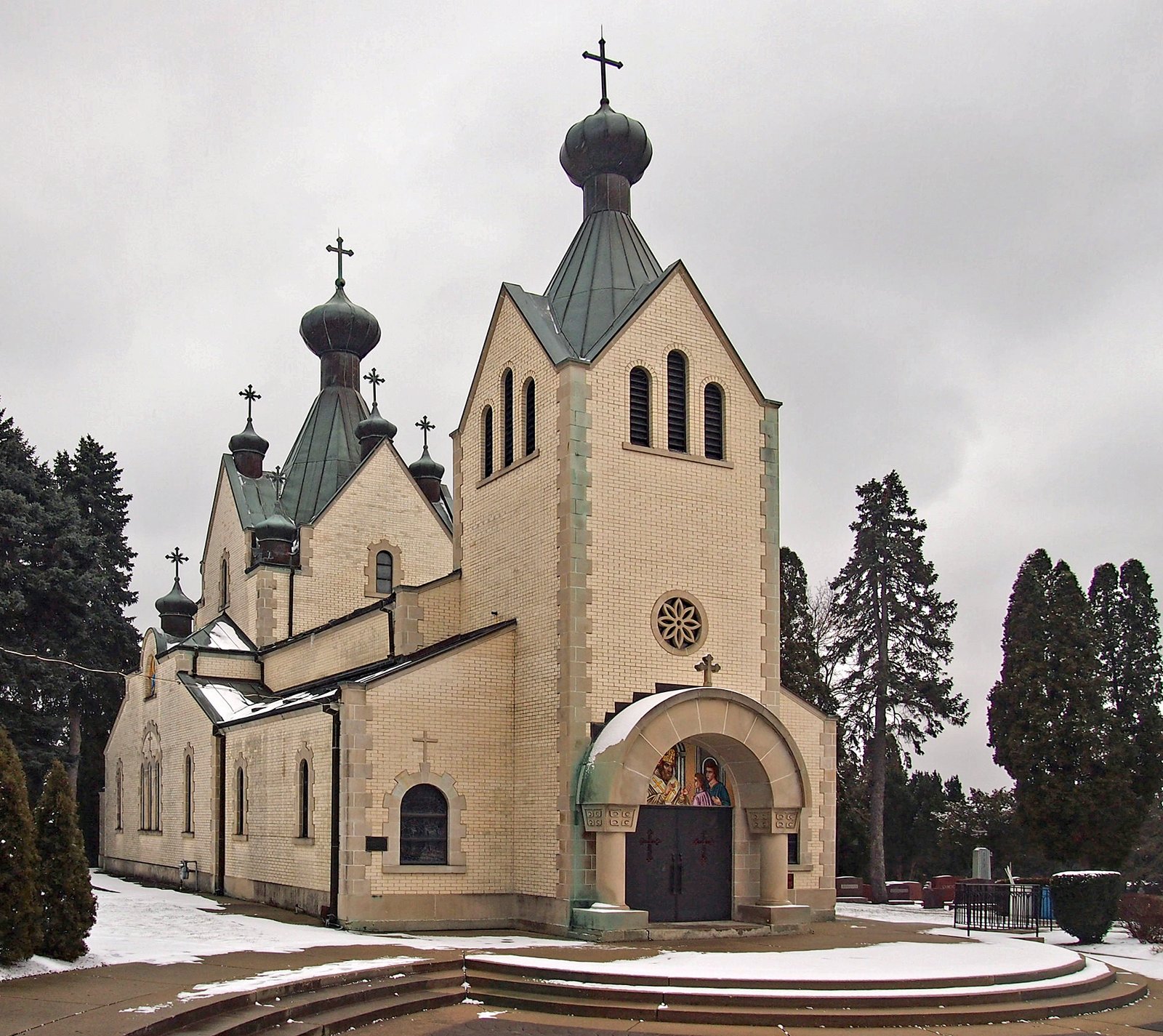
In February 1919, a church council meeting in Cleveland chose a young Serbian archimandrite to be bishop of the Serbian parishes in America. He was not consecrated. He would not accept a bishop's office without the knowledge and approval of his own Church in Serbia, and he went home to Belgrade. Seven years later he was consecrated there, with that approval. Mardarije Uskoković became the first Serbian bishop of America and Canada, and he built a diocese on the principle he held to in 1919: the Serbian Church in America governs itself under the Serbian Church, not apart from it. A few miles from where that council met, Saint Sava Cathedral in Parma has spent the past year under the order he built. This essay compares what he did with what has happened at the parish.
I. An office only the Church could give
Mardarije Uskoković was born in 1889 near Podgorica, in Montenegro. He became a monk as a young man and finished his theological education in Russia, graduating from the academy in St. Petersburg in 1916. In 1917 the Russian Orthodox Church, which then oversaw most Orthodox parishes in North America, sent him to organize the Serbian parishes of the continent into a mission of their own.

Bishop Mardarije (Uskoković), photographed in 1926, the year of his consecration. Wikimedia Commons, public domain.
In February 1919 the Second All-American Sobor of the Russian Church in America met in Cleveland and chose him as bishop for the Serbian parishes. Two things stood in the way of his consecration. Moscow was in the turmoil of revolution, and the blessing of Patriarch Tikhon could not be obtained. And Mardarije himself would not take the office without the approval of the Serbian Church. That year he returned to Belgrade.
The Serbian parishes in America needed a bishop, and the council had chosen one in good faith. But Mardarije did not believe a council in America could make him a bishop without the consent of his own Church.
That principle came back to Cleveland in October 2025. Bishop Irinej of Washington–New York and Eastern America transferred the parish priest of Saint Sava Cathedral to a parish in Johnstown, Pennsylvania, by Episcopal Acts dated October 28. In the Serbian Orthodox Church the assignment of a parish priest belongs to the diocesan bishop. On July 13, 2026, in another case, the Holy Synod said the same: the appointment and transfer of parish priests is an inalienable canonical right of the competent bishop. Some parishioners opposed the transfer. They have held signs outside the cathedral on Sunday mornings, and they wrote to the Holy Synod in Belgrade asking it to overrule their bishop.
Mardarije also took his question to Belgrade in 1919. He waited seven years for the answer and accepted it when it came.
II. A diocese from nothing
In Serbia he was made head of Rakovica Monastery near Belgrade. In 1921 the Holy Assembly of Bishops created a Serbian diocese for the United States and Canada. Mardarije returned to America in 1923 as administrator of the diocese, working under Bishop Nikolai (Velimirović), now venerated as a saint. With his own money he bought land in Libertyville, Illinois, and began building the Monastery of St. Sava.
In December 1925 the bishops of the Serbian Church elected him bishop of the American diocese. He was consecrated in the cathedral in Belgrade in April 1926, by Patriarch Dimitrije. Seven years after the council in Cleveland, he became a bishop with the approval he had asked for.

The Cathedral Church of St. Michael the Archangel in Belgrade, where Mardarije was consecrated bishop in April 1926. Photo: Nemezis, Wikimedia Commons, CC BY-SA 3.0.
In Parma, the parish's administration has been brought back under the bishop's appointees this year. On Saturday, August 15, 2026, under Bishop Irinej's blessing, the administrative handover of the parish to Fr. Dragan Vuković was completed at the cathedral. The protocol and metrical books, archives and seals, mailing lists, and the lists of family slavas and house blessings were returned to the parish.
III. Rules approved by the Church
The diocese also needed written rules. In 1927 Mardarije called the diocese's first Church National Assembly. The clergy and lay delegates of the American and Canadian parishes drafted a constitution for the diocese and sent it to the Holy Assembly of Bishops in Belgrade.
As the Supreme Court of the United States later recounted, the Holy Assembly did not approve the draft as written. It changed it so that the diocesan bishop would be appointed by the Holy Assembly, and so that no amendment to the constitution could take effect without the Holy Assembly's approval. With those changes the constitution was approved, and the diocese lived under it.
Saint Sava Cathedral in Parma is governed the same way today. The cathedral is administered under the Rulebook for the parishes of the Diocese of Eastern America, adopted by decision of the Holy Synod on November 20, 2025, and published on December 10, 2025. The Temporary Board of Trustees acts under that Rulebook. Bishop Irinej was elected by the Holy Assembly of Bishops, and on May 18, 2024 the Holy Assembly expanded his title to its present form. This is the arrangement Belgrade wrote into Mardarije's constitution: the Holy Assembly appoints the bishop, and the Church approves the rules.
IV. An invitation for unity
The diocese of those years was young, poor and spread across a continent, and its parishes did not become one diocese in a single assembly. At a clergy conference in Youngstown, Ohio, in 1931, Bishop Mardarije renewed his appeal to all to work for the unity and the good of the diocese. Reporting on his glorification at Libertyville in 2017, the Orthodox Church in America wrote that his "kindness, patience and reluctance to use punitive measures resulted in a great measure of unity within the diocese" by the time of his death.
On Sunday, December 7, 2025, before the Divine Liturgy, Fr. Dragan Vuković walked out to the parishioners protesting the transfer and invited them into the cathedral, without conditions. The invitation was refused. The answer, caught on video, was "Oni nisu naši," "they are not ours," said of the priest standing at the cathedral door and those who stood with him.
V. What the Church decides
Bishop Mardarije died on December 12, 1935, and was buried at the Monastery of St. Sava in Libertyville, on the land he had bought for it. On May 29, 2015, the Holy Assembly of Bishops decided to number him among the saints. On September 5, 2015, Patriarch Irinej of Serbia led the service of his glorification at St. Steven's Serbian Orthodox Cathedral in Alhambra, California. His feast is December 12.

Bishop Mardarije's grave at the Monastery of St. Sava in Libertyville, as it looked in 1993. The inscription is dedicated to the first Serbian Orthodox bishop of America and Canada by his grateful clergy. Photo: Vujcic, Wikimedia Commons, CC BY 2.0.
The constitution he oversaw came up again decades later, in an American court. After the Holy Assembly removed a later bishop of the diocese in 1963, the dispute reached the Supreme Court. In Serbian Eastern Orthodox Diocese v. Milivojevich (1976), the Court reviewed the history of the diocese, including Mardarije's assembly and the changes Belgrade made to its constitution. It held that civil courts must accept the decisions of a hierarchical church's highest tribunals on church discipline and government. It remains the leading American precedent on the autonomy of churches.
The Parma dispute is now before the same Church. On August 31, 2026, the parishioners who appealed to Belgrade said publicly that they would abide by the Holy Synod's decision. At the Holy Assembly in May 2026, Patriarch Porfirije warned against letting the Church be led by "passing pressures, media-created divisions, or artificially produced conflicts." The Assembly received reports on the dioceses of the diaspora, and its communiqué lists no further action on them.
VI. A century apart
Mardarije acted the same way throughout his life in the Church. In 1919 he would not be consecrated without the Church's approval. When his diocese wrote its first constitution, it accepted Belgrade's changes, which left the appointment of its bishops to the Holy Assembly. In 1931 he was still asking the diocese for unity, and by the time he died he had largely achieved it, through patience and without punishing those who disagreed.
Saint Sava Cathedral in Parma stands inside the order he built: a priest assigned by the bishop, a board acting under rules approved by the Synod, an appeal left to the Church to decide, and an invitation to come in that has stood since the first Sunday it was made. His feast falls on December 12. The Divine Liturgy will be served at Saint Sava Cathedral that week, as it is every Sunday, and the doors will be open.
Sources and Further Reading
- Serbian Eastern Orthodox Diocese for the United States of America and Canada v. Milivojevich, 426 U.S. 696 (1976).
- Orthodox Church in America, Metropolitan Tikhon, Bishop Paul concelebrate at Glorification of St. Mardarije of Libertyville (oca.org, 2017).
- Orthodox Church in America, Bishop Mardarije, Archimandrite Sebastian to be canonized September 5 (oca.org, 2015).
- Orthodox Church in America, OCA represented at canonization of Saints Sebastian and Mardarije (oca.org, 2015).
- Orthodox Church in America, Orthodoxy in America, Part One: From the Russian Mission to the OCA (oca.org).
- Bishop Mardarije: The First Serbian Bishop of America and Canada (eserbia.org).
- Serbian Orthodox Church in North and South America, History (serborth.org).
- Holy Assembly of Bishops, Communiqué of the Holy Assembly of Bishops (easterndiocese.org, May 2026).
- Episcopal Acts Nos. 425, 426 and 427 of Bishop Irinej of Washington–New York and Eastern America (October 28, 2025).
- Rulebook for Parishes, Church Municipalities, Church-School Municipalities and Monasteries of the Diocese of Eastern America (Holy Synod Decision No. 1141, November 20, 2025).
- Video taken outside Saint Sava Cathedral, December 7, 2025, published by Orthodox Integrity.
The Supreme Court's decision in Serbian Eastern Orthodox Diocese v. Milivojevich is available at: https://supreme.justia.com/cases/federal/us/426/696/