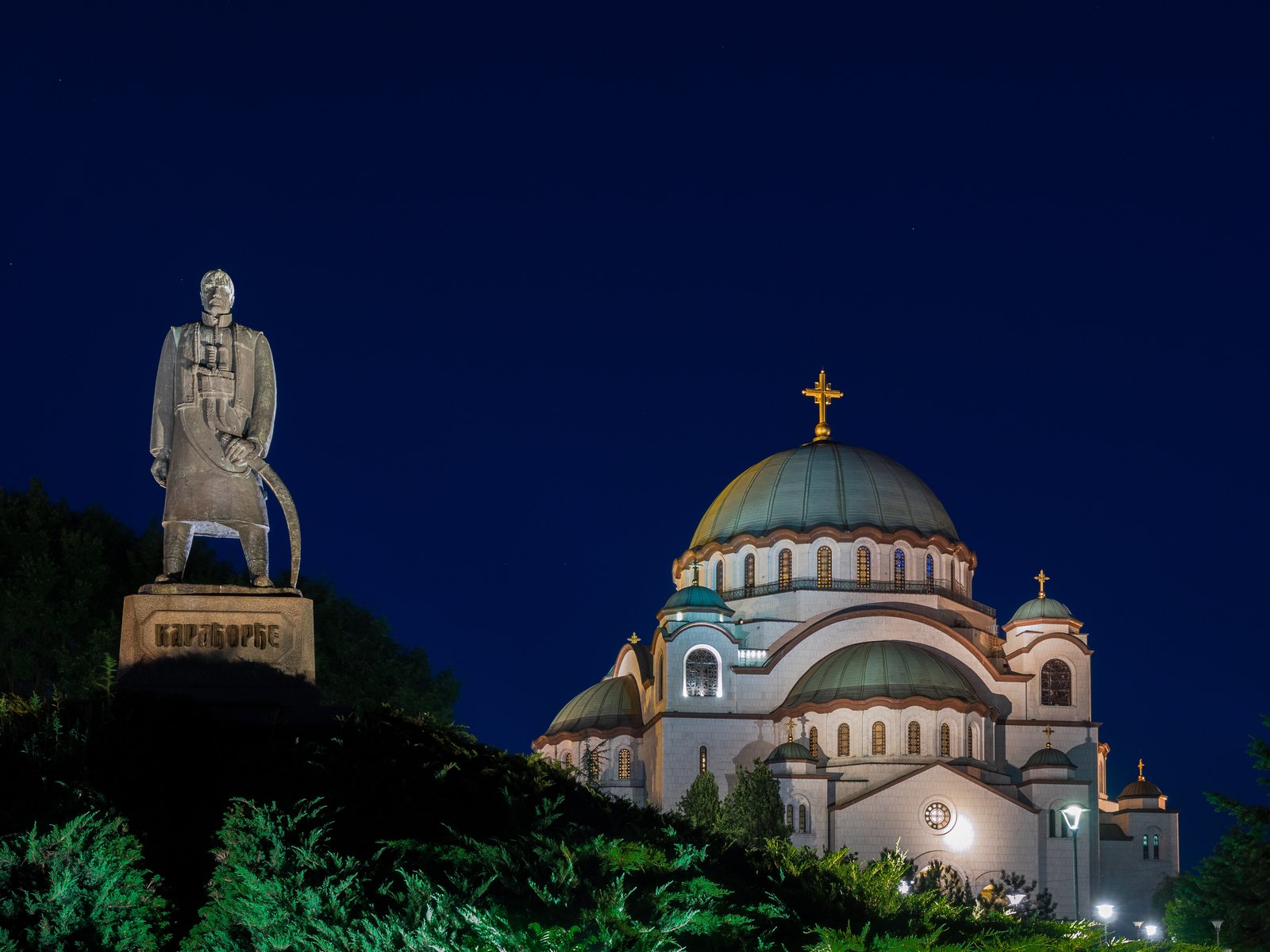
Every Serbian schoolchild knows January 27. On that day the classrooms are decorated, the slava bread is cut, and pupils sing "Uskliknimo s ljubavlju" to Saint Sava, among them many who will never sing another church hymn once they leave school. The Serbian school keeps a slava because the Church gave it one, and its patron is the first Archbishop of the Serbs, the son of a ruler who left his father's court for the monastery. When the students of Serbia held their protest on his feast and walked to his church, they were keeping the slava of their own schools. This essay sets those events beside the life of the saint and beside the Gospel passage that the students' critics have turned into a jibe, and then considers what the Church stands to gain from a generation that came to her doors.
I. The school slava
Savindan became the slava of Serbian schools in 1840, on the proposal of Atanasije Nikolić, rector of the Lyceum in Kragujevac, when the young Principality of Serbia was building its first schools. From then on, the saint who had founded the Serbian Church was also the patron of Serbian learning. Generations of pupils, teachers and professors marked the day with the Divine Liturgy, the slava bread and the hymn.
The new authorities after the Second World War removed Savindan from the schools. It returned in 1990, after nearly half a century, and the hymn came back into the classrooms with it.
In the Serbian tradition a school keeps Saint Sava as its patron in the same way a family keeps the saint of its slava. By that custom, a student who comes to the Church of Saint Sava on Savindan is coming to the feast of his own patron.
II. Two Januaries
The student movement took shape after the canopy of the Novi Sad railway station collapsed on November 1, 2024, killing sixteen people. Its demand from the start was accountability for those deaths. On the first Savindan after the collapse, January 27, 2025, students in Belgrade chose the feast for their first 24-hour blockade, at the Autokomanda interchange.
In the days that followed, Patriarch Porfirije issued a statement after a third student was seriously injured, this time in Novi Sad. In the English text published by Orthodox Times, he called violence against students "absolutely unacceptable" and said that violence "is contrary to all Christian principles." He asked that those responsible be punished according to law, and he added that "the greatest responsibility lies with those in positions of power." He prayed that God would return reason, peace and love to the country.
A year later, on Savindan 2026, students gathered in front of the Rectorate of the University of Belgrade under the slogan "Knowledge is power" and walked from there to the Church of Saint Sava on Vračar. The students reached the plateau shortly after 8:30 in the evening. The church's posted hours end at 8 p.m., and the doors were already closed. The church's administration later explained that the doors close at that hour every evening, and that they could have been opened had a blessing been requested in advance.
On the plateau the students broke the slava bread on the stones in front of the church, as their grandparents had done in the classroom.
III. The prince who left his father's court
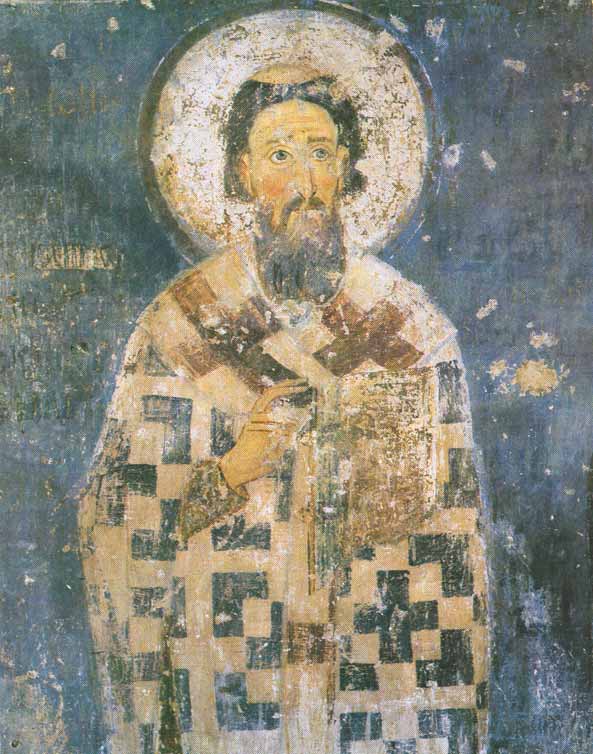
Saint Sava, thirteenth-century fresco in the Monastery of Mileševa. Wikimedia Commons, public domain.
Saint Sava was born Rastko, the youngest son of the Grand Župan Stefan Nemanja. As a young man, around the age of seventeen, he left his father's court for the Holy Mountain and took monastic vows, giving up the power he was born to for a life of prayer and study. With his father, who followed him into monastic life as Simeon, he founded the Monastery of Hilandar in 1198, which became the school of Serbian letters for centuries.
He is best remembered as a statesman for a reconciliation. His brothers Stefan and Vukan had fought each other for their father's inheritance. Sava carried the relics of Saint Simeon from Hilandar to Studenica, brought both brothers to the church, and there, over their father's body, they made peace.
In 1219 he obtained the autocephaly of the Serbian Church and became its first Archbishop. He organized dioceses, wrote the Studenica Typikon and the Life of Saint Simeon, and gave the Serbs the Nomocanon, the book of Church law that bears his name. He died in Tarnovo in 1235. The Ottoman authorities burned his relics on Vračar in 1594 in an effort to break his hold on the people. The Church of Saint Sava now stands on that ground.
Sava was young when he left the comforts of the court to study, and he spent the rest of his life teaching and building up the Church. The students who chose his feast for their largest gatherings, and spent it calling for accountability and for knowledge, were honoring a patron whose own life was given to learning.
IV. Svetosavlje without Saint Sava
The loudest attack on the students this month came from a movement that carries Saint Sava's name. Pokret Svetosavlje of Novi Sad published a long post, signed by Vladimir Mojsilović, against the academician Radomir Saičić for standing with the students. In this publication's translation, it mocked them as "our bloody-pawed, clever youth," said that in an orderly country the police would have trampled the blockaders "like cabbage," and said the university "would have to be cleansed with a sword."
The post accuses Saičić of double standards. Its own are easy to count.
It charges him with noticing rights "selectively," and complains that no one defended a bishop who was questioned by the police. In the same text it wishes police violence on students. Rights, in this view, belong to the people Pokret Svetosavlje agrees with.
It presents itself as the defender of the Church's order against disobedient bishops. Then it calls bishops of the Serbian Orthodox Church "NGO bishops in apostasy" and says they "resemble Women in Black more than shepherds and hierarchs." Obedience is owed to the hierarchy, it seems, only when the hierarchy is on Pokret Svetosavlje's side.
It claims to speak for the Church on the students. The Church has already spoken. In January 2025 Patriarch Porfirije said violence against students is "absolutely unacceptable," that violence is "contrary to all Christian principles," and that "the greatest responsibility lies with those in positions of power." Pokret Svetosavlje did not quote him.
Where an argument needs evidence, the post supplies a conspiracy. The faculties are "a nest of vipers of foreign services," staffed since the nineties by "foundation-funded operatives." The bishops who stood with the students are "in the service of business, globalists and the Constantinople patriarchate." The students' ideas are "the dung of Western values," smuggled in "in Serbian cellophane." The post names no service, no foundation, no payment and no document. Its October post on the Diocese of Eastern America was more of the same. One of its claims was about the Bishop's consecration in 2006. This publication checked that claim against Church records in September. It was false.
It lectures the students about law and order. In one month, posts on its page called for a sword twice: against a university here, and against a bishop of the Serbian Church in America on October 16, which this publication examined at the time.
And it takes its name from a saint who left power to study, who taught all his life, and whose best-remembered public act was reconciling his warring brothers over their father's body. He brought them to church. He took no sword to anyone.
The students who broke bread on the plateau of his church kept his feast. The movement that took his name has not kept his example.
V. If these were silent
The words about the stones crying out come from the Gospel according to Luke, where they are Christ's answer to men who wanted a crowd of His disciples silenced.
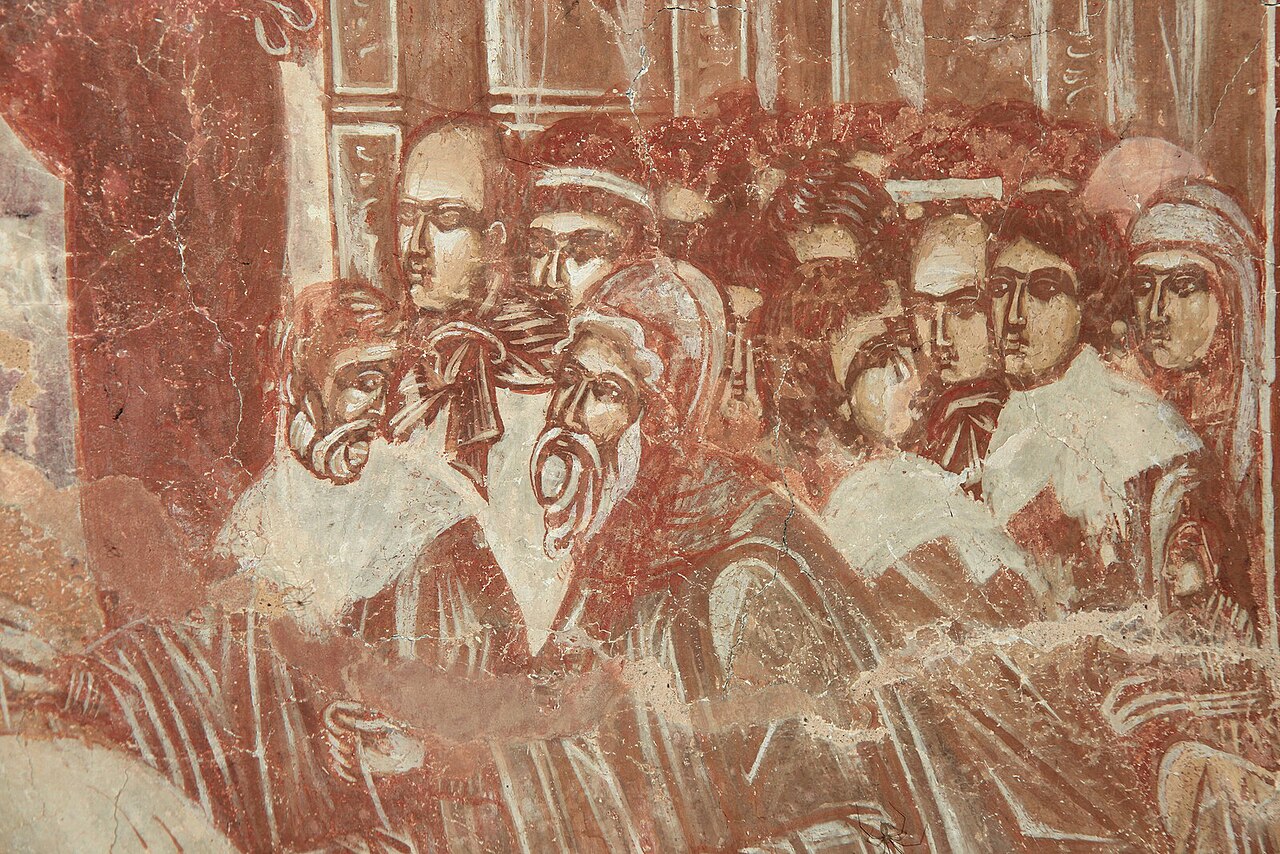
The crowd at the gates of Jerusalem, from the Entry into Jerusalem, Church of Saint George, Prizren. Photo: BLAGO Fund, Wikimedia Commons, CC BY 4.0.
As Christ rode into Jerusalem, "the whole multitude of the disciples began to rejoice and praise God with a loud voice." Some of the Pharisees in the crowd told Him to rebuke His disciples and quiet them. He answered: "I tell you that, if these should hold their peace, the stones would immediately cry out" (Luke 19:37 to 40). Saint Matthew describes what happened the same day inside the Temple, where children were crying "Hosanna to the Son of David," and the chief priests were indignant. Christ answered them with the Psalm: "Out of the mouth of babes and sucklings thou hast perfected praise" (Matthew 21:15 to 16).
In both accounts the demand to silence the young comes from the respected men of the Temple, and in both Christ sides with the people they wanted to quiet.
The Serbian Church marks the occasion with one of its warmest customs. On Vrbica, Lazarus Saturday, the eve of the Entry into Jerusalem, children come to church with small bells on ribbons and walk in procession around the church with willow branches. Nobody asks them to keep quiet that day; the bells are there to be heard.
The verse does not sanctify every slogan, and a protest is not a church service. What the verse records is Christ's reply to the people who asked Him to silence a crowd of His disciples, and to the priests who wanted the children in the Temple quiet. Saint Matthew's account, with the children in the Temple, is read at Matins of Cveti in every Serbian church each year.
VI. What the Church gains
Many of the young people on the plateau that January night were baptized in Serbian churches, and many had sung the hymn to Saint Sava every year of their schooling. Their movement chose his feast and walked to his church, and when the students found the doors closed, they broke the slava bread on the plateau.
For decades the Church has asked why the young stay away from her. In those two Januaries they chose her feast of their own accord, and in the second they came to her door, bringing the customs she had taught them to the church built where their patron's relics were burned.
Patriarch Porfirije said in January 2025 that violence is contrary to every Christian principle and that the greatest responsibility lies with those in positions of power. That statement is on the Church's own record, and it is a sound basis for her dealings with the students from here on. She would gain nothing by treating them as adversaries to be managed. They will be the parishioners, godparents, teachers and priests of the coming half century, and on Savindan they showed that when they looked for something they could trust, they went to the Church.
On October 25, 2026, the day of the parliamentary elections, the Patriarch spoke to the faithful again, in a message on his official Facebook page. In this publication's translation, he said: "I call on everyone that there be no hatred, that this peace we gained at the Holy Liturgy remain in us, that there be no anger." Whatever the outcome, he said, "if we have unrest, if we have anger and hatred, it will be ruinous for all," and he asked each person to act "without fear," taking care "to keep the peace and to protect their brother." He closed by asking everyone to pray "that we remain and be what Saint Sava wants of us." The students went to the church of that same Saint Sava, and the Patriarch's own words give the Church every reason to receive them as his children.
Sources and Further Reading
- Patriarch Porfirije, statement on violence against students (Serbian Orthodox Church, late January 2025), English text as published by Orthodox Times.
- The Gospel according to Saint Luke 19:37 to 40, and the Gospel according to Saint Matthew 21:15 to 16.
- Saint Domentijan, Life of Saint Sava (thirteenth century).
- Teodosije of Hilandar, Life of Saint Sava (late thirteenth to early fourteenth century).
- Dimitri Obolensky, Six Byzantine Portraits (Oxford University Press, 1988), chapter on Saint Sava.
- Vreme, "Savindan protests: From Kolarčeva via Autokomanda to the Rectorate" (January 2026).
- Beta news agency, report on the student walk to the Church of Saint Sava (January 27, 2026).
- Pokret Svetosavlje, Facebook post signed by Vladimir Mojsilović attacking Radomir Saičić and the student movement (October 2026). Quotations are from this publication's translation.
- Patriarch Porfirije, message to the faithful on the day of the parliamentary elections (official Facebook page of the Serbian Patriarch, October 25, 2026). Quotations are from this publication's translation.